Wednesday, November 1, 2017

Tribalism in The Old Testament; Deuteronomy 7, 20

Tribalism
The God of the Bible is very tribal.  The God of the Old Testament is concerned with the well-being of only the faithful among the Jewish people.  In Deuteronomy, other people and cultures are to be swept away with little mercy.  Women prisoners of war are to be forced into marriage with their captors; cities are to be razed, children to be slaughtered – all for the greater glory of God.

Deuteronomy 7 describes the conquests to come.
“The Lord your God will bring you into the land that you are going to occupy, and he will drive many nations out of it. As you advance, he will drive out seven nations larger and more powerful than you: the Hittites, the Girgashites, the Amorites, the Canaanites, the Perizzites, the Hivites, and the Jebusites. 2 When the Lord your God places these people in your power and you defeat them, you must put them all to death.

Deuteronomy 20 continues.
10 “When you go to attack a city, first give its people a chance to surrender. 11 If they open the gates and surrender, they are all to become your slaves and do forced labor for you. 12 But if the people of that city will not surrender, but choose to fight, surround it with your army. 13 Then, when the Lord your God lets you capture the city, kill every man in it. 14 You may, however, take for yourselves the women, the children, the livestock, and everything else in the city. You may use everything that belongs to your enemies. The Lord has given it to you. 15 That is how you are to deal with those cities that are far away from the land you will settle in.
16 “But when you capture cities in the land that the Lord your God is giving you, kill everyone. 17 Completely destroy all the people: the Hittites, the Amorites, the Canaanites, the Perizzites, the Hivites, and the Jebusites, as the Lord ordered you to do.  18 Kill them, so that they will not make you sin against the Lord by teaching you to do all the disgusting things that they do in the worship of their gods.

Many other passages in the Old Testament deal with war against neighboring tribes, and in particular, wars of conquest and genocide “in the land that the Lord your God is giving you.”  There are too many passages to include in a blog post.  But the essence of the passages is that the other people have no right to live, no right to their lands and the cities they have built, no right to live peacefully in their own homes.  Does the behavior of the Old Testament God pass the test of reason and justice?

The words of Deuteronomy are disturbingly close to the Muslim fundamentalist ideas and practices of the Islamic State.  The ethic expressed in the bible calls on other cultures to submit to the Israelites and the Jewish God or be crushed.  The script is the same, whether we are considering the Israelites, Alexander the Great, the Romans or the Mongol hordes.  The God of the Old Testament operates on the same level – submit or die.

Sunday, October 29, 2017

The Protection Racket in the Old Testament; Leviticus 26

The Protection Racket
Leviticus 26 1:13 promises good treatment to those who are faithful to God, while Leviticus 14:46 threatens punishment to those who are not faithful to God.  The essence of the passage is repeated in Deuteronomy 28.  
Leviticus 26
14 The Lord said, “If you will not obey my commands, you will be punished.
I will bring disaster on you—incurable diseases and fevers that will make you blind and cause your life to waste away. You will plant your crops, but it will do you no good, because your enemies will conquer you and eat what you have grown.
18 “If even after all of this you still do not obey me, I will increase your punishment seven times.
...
21 “If you still continue to resist me and refuse to obey me, I will again increase your punishment seven times. 22 I will send dangerous animals among you, and they will kill your children, destroy your livestock, and leave so few of you that your roads will be deserted.
23 “If after all of this punishment you still do not listen to me, but continue to defy me, 24 then I will turn on you and punish you seven times harder than before. 25 I will bring war on you to punish you for breaking our covenant, and if you gather in your cities for safety, I will send incurable diseases among you, and you will be forced to surrender to your enemies.
27 “If after all of this you still continue to defy me and refuse to obey me, 28 then in my anger I will turn on you and again make your punishment seven times worse than before. 29 Your hunger will be so great that you will eat your own children. 30 I will destroy your places of worship on the hills, tear down your incense altars, and throw your dead bodies on your fallen idols. In utter disgust 31 I will turn your cities into ruins, destroy your places of worship, and refuse to accept your sacrifices. 32 I will destroy your land so completely that the enemies who occupy it will be shocked at the destruction. 33 I will bring war on you and scatter you in foreign lands. Your land will be deserted, and your cities left in ruins.  [Good News Translation.]
 ---------

For those who are disobedient to God, in addition to other punishments, God will force the unfaithful to eat their children, due to starvation.  Really?  Is there no consideration for the innocence of children in God’s judgment?  Is this the same God of Love who is presented at church youth camp?  In these passages, God seems to have the character of a mafia “protection” boss, rather than the supreme being of love and ultimate goodness.  Extortion as a process for gaining love and devotion doesn’t seem very divine to me.

Martin Luther, founder of the Reformation, wrote: "If grace depends on our cooperation, then it is no longer grace" (1525. On Bondage of the Will).  And if the love of God depends on intimidation, it isn't love.

Wednesday, October 25, 2017

Religious Genocide in the Old Testament, Deuteronomy 13 & 20, and Numbers 31, 15-17

This post will be the first of several posts examining troubling passages of scripture in the Old Testament.  These verses are rarely read during Sunday Scripture lessons.

Standard Christianity
The Bible
The Bible is an amazing document.  It is amazing for its antiquity, for its content, and that it remains a living keystone of life for many of the people in the world.

However, the inconsistencies and absurdities of the Bible (including multiple creation stories, inconsistencies between the Gospels, anachronisms or general nonsense such as the story of Jonah and the whale) clearly preclude the Bible from being the literal and truthful word of God.  The Old Testament contains any number of fantastical accounts: human lifespans on hundreds of years, the sun stopping in the sky for three days during the battle of Jericho, the plagues of ancient Egypt and parting of the Red Sea, Lot’s wife being turned into a pillar of salt.  If such things are literally true and part of objective reality, why do they not happen today, when the fantastic occurrence can be documented and objectively verified?  Such things do not occur in modern times, and it is unreasonable to think that miracles could only occur in the past.  So, we are left to acknowledge the human authorship of the Bible, and derivation from various pre-biblical texts and traditions. 

But, notwithstanding the human authorship of the Bible and the inclusion of various myths, to what degree should we accept the divinity of the Bible, and its authority over Christian life?  Does the Bible consistently display a standard of morality that should command our obedience and devotion?

Old Testament
The portrait that the Bible gives of God is hardly flattering.  The God of the Old Testament is brutal and fickle, vengeful and prone to human jealousy.  For the moment, I will focus on the book of Deuteronomy. 

Religious Genocide
Consider the horror of the commandments in Deuteronomy 13, for example, which is not often the topic of Sunday’s Scripture reading. 

Deuteronomy 13: Verses 6 – 10
“Even your brother or your son or your daughter or the wife you love or your closest friend may secretly encourage you to worship other gods, gods that you and your ancestors have never worshipped.   One of them may encourage you to worship the gods of the people who live near you or the gods of those who live far away.  But do not let him persuade you; do not even listen to him.  Show him no mercy or pity, and do not protect him.  Kill him!  Be the first to stone him, and then let everyone else stone him too.  Stone him to death!”

And continuing, Deuteronomy 13: Verses 12 – 16: 
“When you are living in the towns that the Lord your God gives you, you may hear that some worthless men of your nation have misled the people of their town to worship gods that you have never worshiped before.  If you hear such a rumor, investigate it thoroughly; and if it is true that this evil thing did happen, then kill all the people in that town and all their livestock too.  Destroy that town completely.  Bring together the possessions of the people who live there and pile them up in the town square.  Then burn the town and everything in it as an offering to the Lord your God".     
[Good News Translation.]

So we are given a commandment of religious genocide.  By what standard of ethics can these verses be considered “good”?

Deuteronomy 13 is particularly ironic in the context of Christian fundamentalists.  For these Christians, who believe in the literal truth of the Bible as the word of God, must honor this passage; but for the ancient Hebrew who first recorded this passage, these Christians worshiping Jesus Christ would surely be among those deserving of death.  I wonder how fundamentalists interpret and rationalize that passage.
 
Religious genocide is a repeated theme through the Old Testament, an ever-present directive in the continuous warfare of the Israelites against their neighbors.  The command is repeated in Deuteronomy 20, as I will discuss in a post on tribalism in the Bible.  These verses in Numbers give a clearer look at the practice of genocide.  

 Numbers 31:Verses 15 - 18
"15 Moses said to them, “Have you allowed all the women to live? 16 These women here, on Balaam’s advice, made the Israelites act treacherously against the Lord in the affair of Peor, so that the plague came among the congregation of the Lord. 17 Now therefore, kill every male among the little ones, and kill every woman who has known a man by sleeping with him. 18 But all the young girls who have not known a man by sleeping with him, keep alive for yourselves." 
 
The reason for the execution of women who are not virgins may be understood in verse 16; it is possible that the rape of captive women introduced sexually transmitted disease to the Israelites.  Concern for plague may have also influenced the ritual treatment of plunder.  In Numbers 31, plunder taken in the course of genocidal warfare must be purified by fire or water before use by Israelites.
 
 The specifics of the genocidal commandments differ from book to book.  Deuteronomy 20 distinguishes between warfare in lands far away and warfare against neighboring tribes.
 
Deuteronomy 20: Verses 13 - 15
"13 and when the Lord your God gives it into your hand, you shall put all its males to the sword. 14 You may, however, take as your plunder the women, the children, livestock, and everything else in the town, all its spoil. You may enjoy the spoil of your enemies, which the Lord your God has given you. 15 Thus you shall treat all the towns that are very far from you, which are not towns of these nations here."
 
But towns and lands near the Israelite's lands are given harsher treatment in the following verses, where the commandment for genocide is complete.
Deuteronomy 20: Verses 16 - 17
"16 But as for the towns of these peoples that the Lord your God is giving you as an inheritance, you must not let anything that breathes remain alive. 17 Indeed, you shall annihilate them—the Hittites and the Amorites, the Canaanites and the Perizzites, the Hivites and the Jebusites—just as the Lord your God has commanded."
[New Revised Standard Version, Updated Edition]
 
To me, as a 21st-century American liberal, these genocidal commandments are horrific.  I am baffled by my contemporaries and fellow-countrymen who continue to look to the Bible for guidance in life.  Our recently elected Speaker of the House of Representatives, Mike Johnson, says that the Bible is his worldview.  
"I am a Bible-believing Christian.  Someone asked me today in the media, they said, 'It's curious, people are curious: What does Mike Johnson think about any issue under the sun?' I said, 'Well, go pick up a Bible off your shelf and read it. That's my worldview.'"
I don't know whether to be appalled that Johnson doesn't understand the Bible, or worried that he does.

That concludes today's Bible study of rarely-heard Bible verses.
 ---


Sunday, February 19, 2017

God as Judge: Heaven and Hell -- The Afterlife, Part II

The Afterlife, Part II, Heaven and Hell
Do the concepts of Heaven and Hell pass the test of reason and justice?

Imagine there's no heaven
It's easy if you try
No hell below us
Above us only sky
Imagine all the people
Living for today
“Imagine” – John Lennon

Please don’t tell what train I’m on, so they won’t know which route I’ve gone.
                                “Freight Train” – Elizabeth Cotten, modified by various folk singers.

Death
Death is perhaps the most unsettling aspect of our existence as sentient beings.  We exist.  As Descartes said, “I think, therefore I am.”  We know our existence had a beginning at conception or at birth, although we do not remember it.  And we know that our existence (as we know it) will cease at death, although it may be impossible to actually contemplate our own non-existence. 

The question of what happens at death has been with us for a long time.  Socrates had something to say about it after receiving his death sentence for impiety and corruption of the youth.  Socrates always had something to say.  That was part of his problem.
“….we shall see that there is great reason to hope that death is good, for one of two things: - either death is a state of nothingness and utter unconsciousness, or, as men say, there is a change and migration of the soul from this world to another.”

“if you suppose that there is no consciousness, but a sleep like the sleep of him who is undisturbed even by the sight of dreams, death will be an wondrous gain…for eternity is then only a single night.”

“….if death is the journey to another place, and there, as men say, all the dead are, what good, O my friends and judges, can be greater than this? If indeed when the pilgrim arrives in the world below, and he has escaped from those who call themselves jurymen in this world, and finds the true jurymen who are said to give judgment there, Minos and Rhadamanthus and Aeacus and Triptolemus, and other sons of God who were righteous in their own life, that pilgrimage will be worth making. What would not a man give if he might converse with Orpheus and Musaeus and Hesiod and Homer? Nay, if this be true, let me die again and again.”

                                                                                Socrates, 399 B.C. in Plato’s “Apology”
“Apology” is the account of Socrates self-defense in his trial for impiety and corruption of the young, in which he was sentenced to death.

American Views about the Afterlife
Socrates framed the question of what happens at death as a duality; either nothingness, or judgment in another place.  In Socrates’ view, judgment was not given by God, but by men who had been righteous in life.  The question of punishment for the sins of this life is not considered. 

In the 2417 years since Socrates, we are no closer to a consensus about what happens at death.

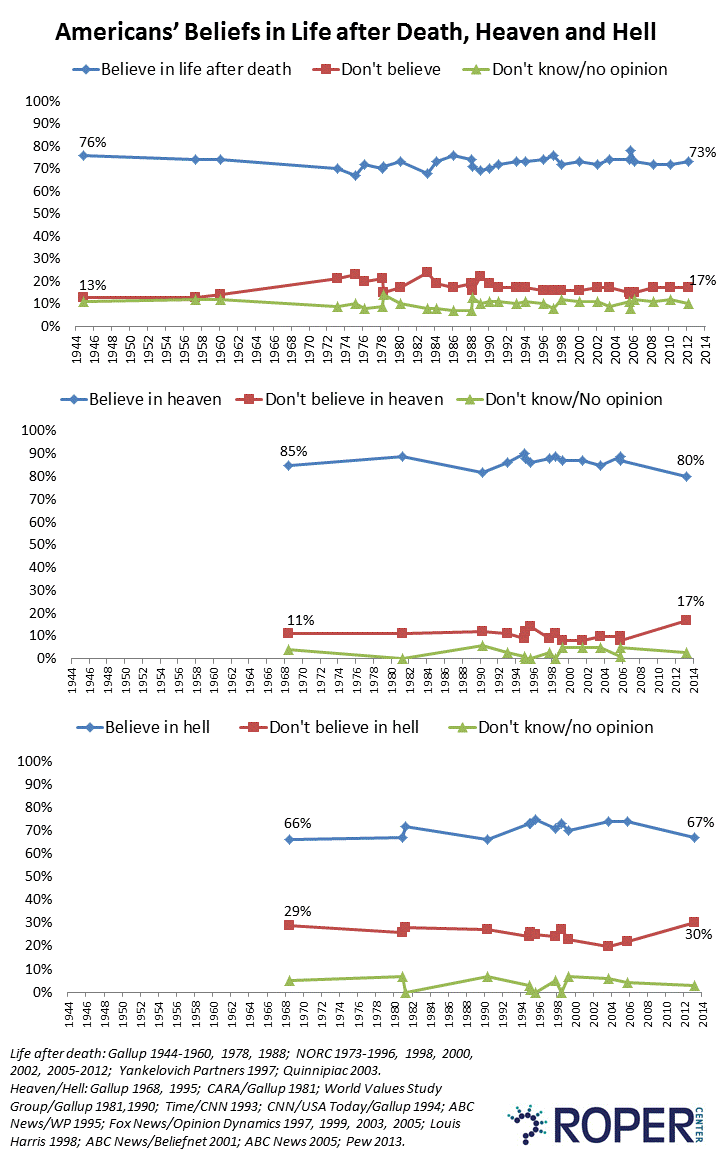
A large majority of Americans believe in life after death, though the specifics of their beliefs varies considerably.   Somewhere between about 70% and 90% of Americans believe in some kind of life after death.  Only a small minority of Americans do not believe in an afterlife.  There is wide divergence of belief in the details of life after death, with a number of inconsistencies in the range of beliefs about immortality. 

Most Americans (about 80%) believe in Heaven.   Curiously, according to one survey, a higher percentage believe in Heaven than those who believe in life after death.  A smaller number (about 60%) believe in both Heaven and Hell.  A minority group believes that a person exists after death and lives on in a spiritual form in another dimension, but not heaven or hell.  About 50% of Americans believe in ghosts here on earth.  About 20% believe in reincarnation.  There is considerable overlap among individuals’ various beliefs about the afterlife, whether about heaven, hell, a separate spiritual existence, ghosts, reincarnation, or some combination of these.

Dante: Inferno, Purgatory, and Heaven
The Divine Comedy, an epic poem written by Dante Alighieri (1265 – 1321), set much of the popular imagery about heaven and hell.  The poem tells of an allegorical journey through hell, purgatory and heaven, as guided by the Roman poet Virgil, and Dante’s life-love, Beatrice.  Each realm of the afterlife is divided into ten circles, representing gradations of sin, circumstance, and merit.  The construct is an attempt to render the afterlife comprehensible from the standpoint of justice.  The simple duality of damnation and paradise is too stark and simple as judgment for the complexity of human experience.  Thus, the souls of pre-Christian philosophers and babies who died before baptism were sent to limbo, in purgatory, according to tradition. 
Illustration of Hell from the 11th century manuscript Hortus Deliciarum (Garden of Delights).

The Christian View of Heaven and Hell
The remainder of this post will focus on the mainstream American Christian belief in Heaven and Hell as destinations in the afterlife.

Jesus will come again with glory to judge the living and the dead.
                                                                -- Nicene Creed
He ascended into heaven, and sits at the right hand of God the Father Almighty:
From thence he shall come to judge the quick and the dead.
                                                                -- Apostles’ Creed

It is interesting to note that in the language of the creeds, judgment does not occur at the moment of death, but happens later, at the second coming of Christ.  This is contrary to a common belief about the immediate disposition of the soul at the time of death. 

The ideas of Heaven and Hell are cornerstones of traditional Christian belief.  These beliefs are directly rooted in the teachings of Christ.   In the Parable of the Sheep and Goats, Jesus says that people who ignore the needs of the poor are cursed, and will be thrown “into the eternal fire prepared for the devil and his angels”.  Jesus also spoke directly of heaven, saying to one of the thieves crucified with him, “Today you will be with me in Paradise”.

The fundamental question here is whether the concepts of heaven and hell pass the test of reason.  Why do we briefly live on earth, if we are to exist for eternity after we die?   And if existence has such an asymmetrical duration, why did God create the realms of life and death? 


Heaven
The Heaven of the Old Testament is quite different than the Heaven of the New Testament.  The Old Testament (Genesis, Daniel, Nehemiah, Kings, Ezekiel, Exodus, Psalms) describes Heaven as the skies above, and the place where God and angels dwell.  Except for Elijah, who was specifically chosen to rise to heaven, it is not described as a place where humans go after death. 

Heaven in the New Testament is quite different.  Jesus speaks often of heaven, of God the Father in Heaven, and of the Kingdom of God in Heaven.  Jesus tells his disciples that they can aspire to Heaven, although he cautions that rising to heaven is not easy.  Jesus says that unless his followers are more righteous than the Pharisees and teachers of the law, they will not enter Heaven (Matthew 5:20), and says that it is easier for a camel to pass through the eye of a needle than for a rich man to enter the Kingdom of God (Matthew 19:24).   

Gustave Dore, Paradise, 1892

But what is heaven, when we get past the cartoons of popular culture -- the pearly gates of Saint Peter and the white-winged angels standing on puffy clouds and holding harps.  What would eternal life be like?  What would it be like after one hundred years?  After the first million years?   After the first billion years?  After the hundredth billion years?  Would any aspect of the human personality persist over such lengths of time?  What is the meaning of eternal life, as promised by Jesus Christ? 

We’ve previously considered the qualities of the human soul, as expressions of the human self: memory, will, self-awareness, thoughts and emotions.  How could these persist for a billion years?  What would remain after these things fade?  Why did God create the realms of life and death, if life in Heaven resembles life on earth?  What does the survival of the soul mean if life in Heaven is different for eternity?  We might consider that the human soul could transform into something else, into a higher kind of being, but for what purpose?  Certainly, whatever might remain after a billion years would no longer be human.  What would such a being do?  What would it think?  Why would it exist, and why would it have begun its existence as a mortal human life? 

Hell
Our idea of Hell as a place of fire and torment is drawn directly from the Bible and the words of Jesus.  It is also clear from the words of Jesus that heaven is reserved for only the exceptional few, the most worthy in the sight of God.   What, then, happens to the rest?  By default, they are consigned to hell, or the middling realm of purgatory, as described by Dante in 1320.

Purgatory, Gustave Dore
Theologians and others have spent considerable mental energy in trying to rationalize the justice implicit in consignment to Hell.  Dante’s Inferno is typical of these rationalizations, where different levels of Hell are allocated according to differing levels of sin.  (I have not read Dante, to my regret.)  For example, pre-Christian philosophers such as Socrates was assigned to the relative comfort of the first circle of Hell, because they lived their lives with honor, virtue and integrity, but were not given the opportunity for baptism or salvation.  Dante’s vision of Hell continues in incremental fashion through moderate levels of torment to the deepest levels, reserved for the greatest sins.   Botticelli’s painting of Hell follows this pattern, with the caverns of hell connected vertically by staircases.  Tormented souls lie prostrate along the halls, and the dungeons become smaller with depth.  [The model implies a skewed statistical distribution of wickedness, with relatively mild sinners greatly outnumbering deeply evil human souls.  The model is intuitively correct.]
The Map of Hell, Botticelli, circa 1480 -1490.

But there is limited fairness in this.  Why did God design a world where honorable men had no opportunity for salvation, simply because Christ arrived too late?  

Calvinists take this idea to a horrifying level based on the presumed omniscience of God.  In the Calvinist view, each soul is predestined at conception for either salvation or damnation.  Indeed, since all is known, each soul is predestined for heaven or hell at the beginning of creation.   What kind of justice is this?   What kind of God would call souls into existence, knowing they are doomed for eternal torment and suffering?  What does this say about free will of humans, individual morality and judgment?  What does this say about the goodness of God?  I am reminded of a scene from Disney’s “Fantasia”, during the piece by Mussorgsky, “Night on Bald Mountain”.  The Ukrainian demon Chernobog (literally “Black God”, representing Satan) conjures a handful of flames into beautiful flaming dancing women.   He then torments them through several transformations, each uglier than the last.  Finally, bored with his game, he crushes them out of existence in his fist.   What is the difference between this and the Calvinist view of God, except that the Chernobog eventually ends the torment of his victims, and the Calvinist God torments his created souls for all of eternity?

Summary
What kind of God would construct hell?  Do the ideas of Heaven and Hell pass the tests of reason and justice?

An Eskimo hunter asked the local missionary priest, 'If I did not know about God and sin, would I go to hell?'
'No,' said the priest, 'not if you did not know.'
'Then why,' asked the Eskimo earnestly, 'did you tell me?'

We tend to rationalize our visions of divine judgment by constructing models which meet our standards of reason and justice.  Thus, we have Dante’s concentric circles of Hell, with degrees of punishment aligned to degrees of sin.  We have the vision of Saint Peter at the Pearly Gates, checking his list like a bouncer at an exclusive nightclub.  But what basis do we have for imagining reward or punishment?   We have scripture, scripture contains none of the detail which is needed to answer questions of justice.  Further, Judeo-Christian scripture is only one of 3000 competing visions of what divine justice means.   We also have our human instinct for fairness, which we share with many higher creatures.   But to construct models of judgment which meet our standards of reason and justice, and then justify those models based on our instinct for sense and fairness is circular reasoning. 

The idea of Hell fails the standard of justice, because the punishment of eternal torment is disproportionate to any conceivable sin.  The idea of hell is also incompatible with the idea of a good and loving God.  Christians who embrace the idea of a loving God must logically reject the idea of eternal damnation, torment and suffering.  Eternal torment is an asymmetric and unjustified punishment for any temporal sin.  And yet we have no basis for ameliorating the model, simply to satisfy our desire for fairness.  The idea either meets the standard of justice, or not.  And it doesn’t.  Either God is not a loving God, or there is no hell.
William Blake, The Book of Urizen

The idea of Heaven fails the standard of reason.  The immortal existence of the soul, extending into infinite time as a coda to our brief lives, also has an illogical asymmetry.  Why is life in the material world so brief, if the soul lives in Heaven so long?   I have a lot of things to do.  There are a lot of things I should do, but I lack the lifetimes to do what needs to be done.  And I could pass eternity in Heaven with a harp, but that will not allow me to take care of real problems here on earth.  A loving and omniscient God working with intelligent design would have given me a little more time on earth and a little less time in Heaven.

Judging God, rather than being judged, is a revolutionary idea.  I freely admit I stole the idea from physicist David Deutsch, in the book “The Beginning of Infinity”, which I highly recommend.  As reasoning beings, we are obligated to judge God (and our beliefs) according to the standards of reason, justice and goodness.   Belief in Heaven fails the standard of reason.  Belief in Hell fails the standards of reason, justice, and the goodness of God.  A reasoning person must reject these beliefs. 
--
Illustrations:


References:
Elizabeth Cotten (1893-1987), grandchild of American slaves, was self-taught on guitar and became a recognized folk artist in her 60s.  Cotton composed “Freight Train” at the age of 11, performed it in public for the first time at the age of 67, and won a Grammy award for the song at the age of 93.
Like many folk songs from 1850 - 1900, the song is an allegory of death, represented as a train.  


Monday, November 28, 2016

Ghosts, Spirits, and Reincarnation -- The Afterlife, Part I

“You don’t believe in me,” observed the Ghost.
“I don’t,” said Scrooge.
“What evidence would you have of my reality beyond that of your senses?”
“I don’t know,” said Scrooge.
“Why do you doubt your senses?”
                                                            “A Christmas Carol” – Charles Dickens

Some questions occurred to me as I considered the question of life after death. 
  • If we are to believe in the afterlife, why did God create the realms of life and death?  
  • For what purpose do we exist while we briefly live, if we are to endure for an eternity after we die?
I will consider these questions in greater depth in my next post, about Heaven and Hell.  In this post I will consider more prosaic concepts of life after death.  This post will consider souls that remain in our own world and walk among us as ghosts or reincarnated individuals.

The Contemplation of Non-existence
People are reluctant to admit the reality of personal death.  It is somehow counter-intuitive to conceive of ceasing to exist, despite the ready analogues of sleep, which we use so frequently as a euphemism for death.  Perhaps we cannot contemplate non-existence, because the contemplation itself presupposes existence.  How could we imagine the feeling of non-existence?  We cannot.  And so, people have developed beliefs based on the continuation of the human self, because we are unable to imagine actual death.

But, for the sake of argument, suppose we accept the idea that people possess an immortal soul.  What do we think about the afterlife?  What conclusions can we reach by thinking about the traditional ideas of ghosts, spirits, heaven and hell? 

A Christmas Carol
Charles Dickens’ “A Christmas Carol” is an absolute masterpiece.  Often performed in film and on stage, "A Christmas Carol" is essential reading for everyone, because of its clarion call for human kindness.  [If you haven’t read it, go read it now.  Seriously, right now.  I’ll wait.]   “Christmas Carol” is also noteworthy for its unflinching look at the dark side of human character, in negligence and cruelty. 


The story is filled with non-human spirits, as well as human ghosts.  The human ghosts suffer for their misdeeds during life – not in hell, as is usually presumed, but through daily coexistence with a world they can no longer touch.  The souls of those who were good in life are not seen floating above the streets of London; presumably they are in a better place.  “A Christmas Carol” is a work of fiction, but it draws on beliefs that are still held by many people.   I suppose if such ghosts were real and sometimes perceived, as by Mr. Scrooge, they would play a rational role in the world, as a warning to others to treat others well during life, exactly as in the story.


Ghosts
I Ain’t Afraid of No Ghosts!
                                                           
Ray Parker, Jr. ,“Ghostbusters”, song

Ghosts conveniently appear when there is no way to document the occasion, and leave no trace, direct or indirect, of their existence.  Some might ask why it is so hard to believe in the unseen, when physicists’ descriptions of reality include such concepts as dark matter and dark energy, which have never been observed in direct interaction with ordinary matter.  Another kind of unseen reality is contained in physicists’ description of the multiverse – an infinite number of alternate realities, existing in parallel with our own universe.   What is the difference between those versions of reality and the idea of ghosts?  The answer lies in the repeatable evidence of the weak interaction of those phenomena with our own physical reality.  Dark matter and dark energy are apparent, even inescapable conclusions, based on the variance of the motion of galaxies from the motion predicted by the theory of gravity.  And evidence for the multiverse is clear and repeatable in the interaction of quantum particles with unseen shadow particles outside of our reality.  What is lacking in the search for ghosts is repeatable evidence.   Is it possible that reality contains elements which are capricious, lacking in physical evidenced, taunting our logic and reason?  It may be possible, but I choose not to believe in such a perverse vision of reality.  (Or in a God who would create such a perverse reality.)   In my opinion (and this is only opinion), there will always be stories of earthbound ghosts, and those stories will always be false.

Reincarnation
And I feel…
Like I've been here before.
And you know it makes me wonder
What's going on under the ground. 
Do you know? Don't you wonder?
What's going on down under you?
We have all been here before, we have all been here before.
                                                                        David Crosby, “Déjà vu”, song.

Reincarnation is another common belief, across many cultures, religions and individuals.  Reincarnation is one of the easiest answers to the question of how the individual self can continue after death.  When the ephemeral body expires, the immortal soul that dwelt within that body moves to another body.    It sometimes provides a rationale for visibly unfair events in an individual life; these are justified according to good or bad deeds in previous life. 

Many religions accept some form of reincarnation as part of the general belief in the eternal life of the soul.  Many of these accept the idea that people may be reincarnated as animals.  The soul’s progress towards perfection depends on willful actions of the individual and resulting karma during each life.   The doctrinal narrative that explains the process of reincarnation is very detailed and complex, and of course, is completely different from one religion to the next.  These narratives are contradictory and cannot all be true.

Some versions of reincarnation are attributed to only people.  For example, actress Shirley McClain believes that she has lived many previous lives, beginning sometime in our pre-human past.  (The fact that McClain’s version has no resemblance to archeological or biological evidence doesn’t dissuade her from her belief.)  There are books and websites on how to find and remember our previous lives. 

The on-line literature regarding reincarnation is filled with tangential ideas, equally without a basis in evidence, and contrary to known facts in established science.  The literature references extraterrestrials; the possibility of extraterrestrial past lives; fabricated and incorrect cosmology, evolution, and geology.

When I researched this topic, I found, somewhat to my surprise, that many more people have died than are living today.  In rough numbers, about 100 billion people have lived and died since 50,000 B.C.*, and roughly 7.5 billion people are alive today.  So, for every person living today, about 14 people lived and died before that us.  In concept, enough prior humans existed that all of us could have lived a previous life, or many lives.  Most of those lives were lived sometime between about 200 B.C. and 1950 A.D. 

*There is an open question about when humanity began.  The demographer who produced this research chose 50,000 B.C. arbitrarily, whereas anthropologists might choose 100,000 to 250,000 years ago.  The truth is there is no clear dividing line between humans and pre-human progenitors.  We cannot say “This being has a soul, but its parents did not.”  This was the point of my childhood question, “Does a virus have a soul?”

Many people believe in reincarnation today, including about one-quarter of American Christians, although reincarnation is not part of Christian theology. 

The possibility of reincarnation is even the subject of serious academic research at the University of Virginia.  For over 40 years, researchers there have been gathering evidence that young children remember previous lives.  According to the researchers, these memories fade by the age of six. 

But if only a few children out of millions remembers a previous life, and if those memories fade by the age of six, can we even say that the previous soul survives?  If we have no memory of our previous selves, do those souls still exist, or have they evaporated, to be replaced by the soul of the presently living individual?

Further, why should memories of past lives only occur in a tiny handful of cases, in children?  Isn’t it possible that parents have misconstrued things said by children, or unconsciously planted ideas in the children’s heads, that later appear to be memories?  Is it possible that all of these stories are some kind of fraud?   The evidence for reincarnation is sparse, not systematic or repeatable, and of questionable authenticity. 

Carl Sagan advocated a principle which should be part of the foundation for any system of belief.  That principle was first proposed by French mathematician Laplace, in 1812: “The weight of evidence for an extraordinary claim must be proportioned to its strangeness.”  Sagan’s formulation is more succinct: “Extraordinary claims require extraordinary evidence.”  The claim that an immortal soul exists for each human, leaves the body at death, and resumes its existence in another person, or an immaterial place, is certainly an extraordinary claim.  And the evidence for that claim is weak.

Conclusion
Most modern people have stopped believing in ghosts.  There are always legends, and there are always things that startle us in the dark.  But those things have more to do with our human senses, and our brain’s tendency to fill in the blanks when deprived of sensory input.   No clear, repeatable evidence for ghosts has ever been gathered. 

Similarly, there is no convincing evidence of reincarnation.  Accounts of individuals remembering previous lives are very sparse and poorly documented.  The instances of remembered past lives are not sufficiently abundant to rule out fraud, or unwitting communication of information to the “reincarnated” individual.  The idea lacks the robust evidence required to validate belief in something unseen.

The idea of life after death, whether as a ghost, or reincarnated soul, fails the basic test of reason.  Why should life of the soul continue after death?   At some point, early human individuals must have possessed “original” souls.  Why would later individuals receive “recycled” souls?  If reincarnation were an actual phenomenon, perceptible to humans, then the beliefs of various cultures and religions would be expected to be parallel, because they are describing the same real phenomenon.  But world beliefs about reincarnation are not at all parallel, and for that reason, we must conclude they are false.

---

Does a Virus Have a Soul? -- Summary
An earlier post in this series explored the question of the immortal soul.   (“Does a Virus Have a Soul? http://sensibledisbelief.blogspot.com/2016/07/does-virus-have-soul.html).   To summarize the earlier inquiry, there are qualities of life which give us personal identity -- memory, will, self-awareness, thoughts and emotions.  There is considerable evidence that these capacities are located in the brain, and are erased at death.  There is no compelling evidence that the components of the individual self exist past the moment of death.  There is no evidence of any other receptacle for the self which can hold the self beyond the moment of death.  So the existence of the soul, which is considered the immortal continuation of our self, our personal identity, is without basis.  Further, when we consider the connectedness of life, through evolution and the complexity of the human organism, the notion that only humans possess a soul develops logical contradictions.
--
References:

Reincarnation:

Scientific research into reincarnation:

History of past lives:
6.5 % of the people who have ever lived are alive today.

Saturday, October 29, 2016

God as Sustainer of All Things

In the book The Beginning of Infinity, physicist David Deutsch imagines the following dialogue between the philosopher Socrates and the Greek God Hermes:

Hermes, speaking to Socrates: “How many [Athenians] are willing to criticize a god by the standards of reason and justice?”
Socrates, [ponders]: “All who are just, I suppose.  For how can anyone be just if he follows a god of whose moral rightness he is not persuaded?  And how is it possible to be persuaded of someone’s moral rightness without first forming a view about which qualities are morally right?”
“A Dream of Socrates”, in The Beginning of Infinity, by David Deutsch, 2011
The dialogue was drawn from themes in Plato's "Apology", the account of Socrates' self-defense in his trial for impiety and corruption of the youth.

In the traditional Christian view of God, God is creator of all things, sustainer of all things, and judge of all people.  From Scripture, particularly John 1:3, we learn that nothing was made without God; nothing exists without God.  God is in all things, rules all things, determines all things.  In this post we will consider the role of God the sustainer of the world. 

I recently attended a session of Alaska’s excellent story-telling forum, Arctic Entries.  The monthly programs allow people in the community to tell stories of their lives.  In the most recent show, a story-teller told of an improbable and horrific accident.  While swimming in a lake with other young people, a rope from a boat somehow became wrapped around his neck, just as the boat departed at high speed.  The young man survived, but suffered a stroke which left half of his body paralyzed.  The young man was a church leader in a mentoring program for high-school students; he had given of his time and wisdom to make their lives better.  So why, of the eleven people on stage, was he the one to suffer a physically and mentally crushing random injury?  Where is the God who is in all things, determines all things, and rules all things?

If we take David Deutsch’s dialogue of Socrates to heart, we are not only permitted, but obligated to question God’s performance as the sustainer of all things, according to rational standards of justice and goodness.
God the Father, Julius Schnorr, 1860

Making Excuses for God -- When Bad Things Happen to Good People
Everybody knows that bad things happen to good people.  Theologians and religious people acknowledge that this is one of the most difficult issues with faith.  There is a huge volume of religious literature dedicated to the topic of explaining the injustices of life to those who have suffered pain, injury, and tragedy.  The literature tries to help people make sense of their loss, to reconcile the evil they have suffered with the fundamental goodness of God. 

People make excuses for God.  When bad things happen, people can always provide an explanation.  Here is a short sampling of the excuses I have heard for why God allows suffering to exist.  I have taken many of these verbatim from religious websites; others I remembered from sermons and teachings from childhood.  The essence of these excuses is that bad things happen, but it is never God’s fault.
  • God has a higher purpose.
  • God is testing our faith.
  • God is not responsible for all the evil that is happening around us; Satan is. 
  • People are wicked.  The innocent suffer, along with the wicked.
  • God always answers your prayers, just not always in the way that you want.
  • God allows suffering because troubles make you stronger.
  • God allows suffering because people have been granted free will.  Other peoples’ sins and decisions cause the innocent to suffer, but it isn’t God’s fault.
  • Good people suffer on Earth, because the reward is in Heaven. 
  • God wants the loved one in Heaven.
  • Suffering in this world doesn’t matter, because eternity makes the difference.
  • Pain awakens us to God.
  • If we understood why innocents suffer, we would be unmoved, and that would be unthinkable.
  • God is able to restore the life of the child, so from God’s perspective, there’s no loss.
  • All people have sinned, and people share the sins of others, so there are no good people.
  • God allows bad things to happen to good people to teach them lessons, to discipline them, to improve their character, to encourage them to depend on him, etc.
  • God did not create people to suffer, but sometimes we do suffer because we live in a fallen world.
  • Evil entered the world when Adam and Eve disobeyed God.  We live with suffering as a consequence of their disobedience.
  • Trust in God; God knows what he is doing.
The sheer number and variety of excuses for God suggest to me that there is no appropriate answer for God’s apparent indifference to human suffering.

If we continue along the path suggested by David Deutsch, we should question God according to the standards of reason and justice.  It is easy to frame responses to each excuse for God’s indifference, as follows:
  • Is God, the omnipotent, unable to accomplish his higher purpose without causing suffering?
  • Is God unable to differentiate the good from the bad, and treat each accordingly?
  • Why does the reward in Heaven require suffering on Earth?
  • What kind of kindness is represented by testing humans with cruelty?
  • God has all of eternity; if he wants somebody in Heaven, why can’t he wait?
  • If a prayer is for mercy and goodness, why would it be denied?
  • Why is it necessary to cause suffering in order to teach someone?
  • What kind of relationship relies on punishment to enforce loyalty and obedience?
  • Why should anyone suffer for the sins of others?
Despite promises in the Bible and liturgy, God doesn’t intervene to provide justice in human affairs.  As I have done in other posts on this blog, I could provide examples; lists of injustices in human experience.  But that is unnecessary.  For every article about faith repaid by divine intervention in Guidepost magazine, everyone knows there are innumerable examples of undeserved tragedy, throughout history.  Many of those tragedies are of human doing, but many are natural disasters – in legal parlance, Acts of God.  And if natural disasters inflicted on the innocent are in fact, acts of God, should we not judge God according to the standards of reason and justice?

Mercy is innate, through-going and consistent behavior.  God’s mercy should not be capricious or biased, threatening or conditional.  We should criticize God according to the standards of reason and justice when we consider the problem of suffering in the world.

When Good Things Happen to Bad People
Good things also happen to bad people.  This is the converse of the usual paradox, although it is examined less often.  In fact, we know that good things happen to all kinds of people, and bad things happen to all kinds of people.  Throughout history, the innocent and good have suffered equally with the wicked; the wicked have prospered as much as the deserving and just.  It’s pretty clear that ethical or moral merit just doesn’t matter when it comes to cancer, debilitating illness, and early death.  And wicked leaders such as Ivan the Terrible, Josef Stalin, Robert Mugabe, Muammar Gaddafi, Idi Amin and others survive and prosper, unless brought down by the concerted efforts of men, not God.

Conclusion
In the course of writing this post, I realized that Hans Christian Anderson’s story “The Emperor’s New Clothes” is perhaps about religion.  People generally believe what they are told by a person of authority.  When people are taught from birth, they will fiercely believe in those things despite evidence from their own experiences and senses.  In Anderson’s story, only a child could acknowledge what was plainly seen by all – that there was nothing there. 

People stubbornly hang on to what we were taught as children.  Some people who were taught that Pluto is a planet are deeply distressed by the scientific re-classification which changes that status.  People are taught to trust in God, as they trust in their parents.  Some psychologists even say that that we are pre-wired to believe in God.  And so, people retain their belief in God, regardless of their life experiences, and regardless of how contradictory those experiences may be compared to the teachings about God from childhood.  Gaining release from those beliefs requires critical, objective thought, contrary to some of our earliest instruction.  It isn’t easy.

Human experience is incompatible with the traditional concept of God – omniscient, omnipotent, infinitely good, Creator and Sustainer of the world and mankind.  The suffering which mankind endures is simply incompatible with such a God.  God, if he exists, is either not infinitely good, not infinitely powerful, or not interested in mankind.

---
References:
David Deutsch, 2011, "A Dream of Socrates", pp. 223 - 257, in The Beginning of Infinity, p.496.
Plato, Apology, c. 399 BC.  (Apology is Plato's account of Socrates' speech at his trial for heresy and corruption of the youth.  The trial ended in Socrates death sentence, which was carried out some months later.  In my view, Socrates was approaching the idea of monotheism, and used the term "the god", whenever he spoke of his own faith.), in Plato, Five Dialogues, translated by G. Grube and J. Cooper.
The Bible, John, 1:3.