Showing posts with label Socrates. Show all posts

Monday, June 24, 2024

The Angry Atheist

Abstract/TLDR Version:
Atheists have a reputation for being angry.  It’s true.  I am angry.  I’m angry about the violence perpetuated in the name of religion.  I’m angry about the persecution of humanity’s greatest thinkers for questioning religious dogma.  I’m angry about the loss of human knowledge through the ages by the destruction of ideas in conflict with religion.  I'm angry about the repression of Native cultures in the name of religion.  I’m angry about the exploitation of followers by religious authorities and organizations for money and sexual abuse.  I’m angry about religious infiltration and distortion of modern politics.  I'm angry about the infiltration of religion in the public schools and public venues.  But above all, I’m angry that 2400 years after the execution of Socrates, religion is still the overwhelmingly dominant belief in society.  In the two millennia since Jesus Christ, some of the greatest philosophers, thinkers and writers have considered aspects of religious doctrine, and failed to consider the most basic question – “what if none of this is real”?  Why is this left to me, in the 21st century, to point out that the emperor has no clothes?  There is no evidence today that supports the existence of the supernatural world, and logical reasoning yields the conclusion that God does not exist, given the world that we see.  I have other important problems to deal with but here I am, blogging about atheism.


Image Note:
I wrote this entire post, then searched for an appropriate image to convey my notion of the angry atheist.  To my delight, I found the cover art of a book by Greta Christina drawn by Casimir Fornalski.  This image perfectly captures the sentiment I was looking for in this blog post.  To my even greater delight, I ordered and read the book, “Why Are You Atheists So Angry? 99 Things that Piss Off the Godless”.   Not surprisingly, Greta Christina touches on many of the same themes and examples I used in my post, and did so much better and more completely.  Christina’s book is an excellent rendering of everything I am trying to say.  Please buy and read this excellent book.  
---------------------------------------------------------------------------------------------------------------------
Atheist.
For a moment, look at the word, and picture that person in your mind’s eye.  What kind of person do you see?  How do they speak?  Do you find that person friendly?  Pleasant?  Attractive? Or unpleasant and disagreeable?

As an atheist myself, I find that I don’t have positive associations with the word.  In my experience, too often, other atheists have been argumentative and disrespectful of others’ beliefs.  I’ve developed a bias that presumes atheists are angry, tedious and tiresome.  

In this blog, I have often mentioned a particular atheist college classmate.  She is relentlessly dismissive of the beliefs of others, aggressive, tedious and tiresome in her interactions on social media.  On the positive side of the leger, her loud advocacy of atheism has enabled a number of other classmates to admit that they, too, are atheists.  Perhaps I am a member of that group.  

I know that pleasant atheists exist; I’m acquainted with several.  For the most part, they keep their disbelief to themselves, do not challenge others’ beliefs.  Like gay people of the last generation, they stay in the closet.  

Is it possible to openly be an atheist, without confronting and challenging the beliefs of religious people?  It seems as though the very existence of atheism challenges religious belief.  When I have presented my disbelief on social media, the interaction seems to end in one of two ways: 1) “You will burn in hell  and regret your choice for eternity”, or 2) “I will pray for you,” which is a passive-aggressive way of disrespecting my convictions.

There’s a stereotype that atheists are angry, perhaps with good reason.  Just Google images for “Angry Atheist” and you’ll find abundant discussion threads and images.  The results include a cheerful yellow mug with the words “Angry Atheist”, Angry  Atheist buttons, blog posts, books, newspaper articles, and lots of images of people screaming.  As mentioned above, this is how I found the book cover for the book by Greta Christina, which perfectly represents the theme of this post.

In her book “River of Grass”, Marjorie Stoneman Douglas mentions an incident involving a boat in a storm.  A man was captain of a small sailing boat; his passengers were his father and a pastor.  At a critical moment in the storm, the captain ordered the pastor to cut the mainsail to stabilize the boat.  Instead, the pastor fell to his knees, and loudly prayed for the Lord to save the boat.  The boat crashed, and the captain’s father died.  For the rest of the captain’s life, whenever he encountered a discussion about faith, he angrily argued for atheism and against religion.

Atheists are angry out of empathy for the boat captain, for this incident, and for thousands of other events over the centuries.  The following paragraphs are a list of things to be angry about.

War, Murder and Violence in the Name of Religion
I have to admit, I am angry.  I’m angry about the Crusades.  I’m angry about the Aztec prisoners who were killed to appease the gods, the ritually slaughtered neolithic Danish bog victims and the Mayan youth thrown into cenotes, and the murder of Plains Indian children for the power of their spirits.  I’m angry at the ritual murder of the children of Inca chiefs, and the present-day ritual murder of children in Africa for the purpose of folk medicine.  I’m angry about the 70,000 concubines, servants and their families who were buried alive to serve Emperor Qin Shi Huang in the afterlife.  I’m angry about the servants and concubines killed and buried with Egyptian pharaohs and Scythian kings.

I’m angry about the tortures of the Catholic Inquisition and the persecution of Jews.  I’m angry about the roughly 50,000 women who were executed as witches in Europe and America between 1400 and 1775.  I’m angry at the violent deaths of up to 2,000,000 people in the religious violence during the 1947 partition of India and Pakistan.

I’m angry at the sacrifice of animals to appease the gods, which was practiced in more religions than I can name, or the killing of animals to accompany humans after death.

Violent Repression of Independent Thinkers
For millennia, religious traditionalists have repressed or killed some of the brightest humans to ever live.  This repression of independent thought inhibited other inventive, philosophically-minded people.

I’m angry that religious traditionalists tried and executed Socrates for crimes of impiety and corrupting the youth of Athens.   I’m angry about the death of Hypatia of Alexandria, a pagan philosopher, astronomer & mathematician murdered by a mob of Christians.  Giordano Bruno was the first known person to realize that stars were distant suns which might have planets and life.  Bruno who was burned alive in 1600 for suggesting that Mary was probably not a virgin, the Holy Trinity really didn’t make sense, and eternal damnation wasn’t consistent with the notion of a loving God.  Galileo wasn’t executed, but was threatened with torture and silenced by the Catholic Church.  The persecution of Galileo (who was pardoned by the pope 359 years later) ended the development of Renaissance science in southern Europe, leaving northern Europe to continue the advancement of civilization.  I’m angry about that.

Destruction of Human Knowledge in the Name of Religion

I’m angry about the destruction of books and records for religious reasons.  The Wikipedia article “List of Destroyed Libraries” (https://en.wikipedia.org/wiki/List_of_destroyed_libraries) lists dozens of libraries from antiquity to modern times which were destroyed because they contained texts at odds with the prevailing religion.  The libraries include the library at Alexandria (destroyed in several events, not all of which were religious).  At Alexandria, Caliph Omar gave this order: "If those books are in agreement with the Quran, we have no need of them; and if these are opposed to the Quran, destroy them."  I’m angry at the nearly complete destruction of Mayan and Aztec written works by Spanish conquistadors and Catholic priests.  Religious purges of libraries also happened in China, India, Greece, Spain, England, Iran, Iraq, Afghanistan, Constantinople, etc.  At Cordoba, all books containing “ancient science” were destroyed as heretical.  How much farther would civilization have advanced if this knowledge had not been destroyed?

Repression of Indigenous Cultures
I’m angry about the repression of indigenous cultures in the name of religion.  Across the world, Western missionaries moved to far-flung parts of the globe, often on the heels of military invaders, and taught indigenous peoples that their beliefs and customs were wrong.  Varying degrees of coercion were used.  Entire languages were eradicated; written literature, history and knowledge were burned.  Cultural norms of ownership, family structure, diet and construction were erased.  Some of my ancestors participated in that destruction.  In a world without missionaries, we would have much more human cultural diversity today, and a wider range of knowledge and art.  To me, perhaps the worst of it is that missionaries replaced native beliefs with fraudulent beliefs.  It may have been correct that there are no animal or ancestor spirits to worship, but the religion that replaced these superstitions is equally false.

Incredibly, repression of Native culture is still happening today, in the United States.  Today, The Guardian reported on a recent event in Arizona, in which Native Apache teen girls were expelled from a Lutheran school for performing in a traditional Native ceremony.  The girls were sent a letter by the school, offering to re-instate them if they confessed that they were worshiping the devil in the Native dance, and that they promised not to do it again.  The expulsions were part of a long-standing pattern of denigrating and suppressing Native culture.  Apparently, religious freedom only applies to the predominant Christian religion.  I'm angry about that.

Exploitation of Followers by Religious Authorities

In my blog post “Is Religion Benign? Part I”, I discuss a number of financial and sexual scandals involving religious leaders.  It seems that sexual scandals are an occupational hazard for televangelists and megachurch pastors, and I don’t need to repeat reporting on pedophile Catholic priests.  It is disturbingly common for individuals who have gained the trust of religious believers to exploit that trust for sex and money.  I’m angry about that.

There’s further institutional financial exploitation by churches.  Large churches accumulate massive amounts of wealth from members’ donations.  The LDS (Mormon) church holds an investment fund worth about $50 billion, or about $3000 per member.  The Catholic church also holds a massive amount of wealth.  Relatively small discrete parts of the church are known to hold assets in excess of $73 billion.  Not included in that estimate is real estate which extends over an area the size of Texas.  Other denominations have also accumulated much wealth on an institutional scale.

So what’s the problem?  Shouldn’t parishioners be free to spend their money in donations to these businesses?  (I do consider churches to be businesses.)   The problem is that the product these businesses are selling is a fraud.  Imagine ordering something from Amazon that was advertised to help you in your daily life and give you eternal life after death.  The seller is offering an invisible product that will be delivered to your door in an invisible box.  All you have to do is send the money and believe in the invisible box.  Wouldn’t you have a problem with that?  I do.  I’m angry about that.  I’m angry on behalf of the people who are being defrauded.

In the United States, as in most countries, churches do not pay taxes.  It is clear that churches are not non-profit organizations.  They’re simply businesses selling an invisible fraudulent product, and paying no tax on their earnings.  Communities could benefit from those taxes.  I’m angry about that, too.

The Modern Conflation of Religion and Politics
I’m angry that the modern conservative movement has coopted and conflated fundamentalist Christianity with Republican politics.  Christianity, as  seen in the actions and words of Christ, rejects religious authorities, criticizes the wealthy and lifts up the down-trodden of the world.  If anything, it is a leftist religious ideology.  Somehow these priorities have been swept aside by conservatives, who imbue their political campaigns with the infallibility of faith in God.  It is a mutual corruption of the religion and of the political system, especially the constitutional separation of church and state.

I've written previously about the Seven Mountains movement on my political blog (here: https://debatablypolitical.blogspot.com/2022/07/the-seven-mountains-movement.html).  This movement is part of the Christian Nationalist movement that intends to create an American Christian theocracy, eliminating American religious diversity.  I'm angry about that, too.  

Infiltration of Religion into Schools, Public Venues and Public Events
The state of Louisiana now requires that the Ten Commandments be posted in every public classroom.  Posting the Ten Commandments is clearly unconstitutional, and was rejected by the Supreme Court over 40 years ago.  Nevertheless, religious conservatives continue in their efforts to indoctrinate children and mold society according to their ideology.  Similarly, there are continuing efforts to post the Ten Commandments in courthouses and government buildings.  The supposed justification for this is the asserted foundation of Western ethics and law in the Ten Commandments.  But the real reason conservatives want to post the Ten Commandments is the first Commandment: “You shall have no other God before me.”  The intent is to discredit non-Judeo-Christian religions in the minds of children and throughout society.  Conservatives’ justification for posting the Ten Commandments is false and disingenuous.  I’m angry about that.

It is common to have a prayer invocation before government meetings, graduations, convocations and other public events.  Why do we do this?  While some jurisdictions rotate responsibility for the invocation among different denominations (and are lampooned by Satanists and the Church of the Flying Spaghetti Monster), why do we have prayer at public functions at all?  If an event is a religious gathering it is fair to begin with a prayer.  If the event is not a religious event, there should not be a prayer!  I’m angry about the disregard for those who do not believe.

The Persistence and Modern-Day Existence of Religion
Of all the reasons to be angry at religion, I am most angry that religion still exists.  From the perspective of our stone-age ancestors, religion made sense.  Religion provided an explanation for the mysteries of the world.  Lightning?  It was the gods.  Sickness?  The gods.  Success or failure?  The gods.  Seasons?  The gods.  Marine fossils in the mountains?  Clearly the gods.  Good luck or misfortune?  Definitely due to obedience or disobedience to the gods.

But today we understand things better.  We know why lightning, sickness, seasons and mountains exist.  We understand that random events produce results that can be good or bad for people.  Today, there is no reason to believe in gods, or evidence that gods exist.  Observation and reasoning show that we do not live in a world consistent with the existence of the kind of god promoted by mainstream religion.  

We often denigrate religions of primitive or historic cultures, presenting those religions as superstition or myth.  Even in fiction, we often show primitive people worshipping false gods.  But we rarely cast that critical eye on religions of our own culture.  Instead, we accept Judaism, Christianity, Islam, Buddhism, Hinduism, Shinto, Sikhism, Baha’ism and Taoism more or less in the same form they have had for a millennium or more.  I might note that Voodoo, with four times the number of adherents as Judaism, is generally rejected by Americans as superstition, while some of the rest are generally accepted as a legitimate variation on the worship of God.

But why do religions persist?  Are they all not superstition, attributing consciousness, will and agency to non-material spiritual entities, of which there is no evidence?  In the 2000 years since Jesus walked the earth, why haven’t people separated the message of kindness and forgiveness from the mystical message about the existence of a father in heaven?  Of the great thinkers through the ages, why didn’t Augustine of Hippo, Thomas Aquinas, Martin Luther, Erasmus, Spinoza or Voltaire conclude that religion was entirely nonsense?  Many of these thinkers were critical of the religion of their time, but none of them took the crucial step of recognizing that nothing about religion is true.

So, in the year 2024, about 90% of my fellow Americans believe in some kind of immaterial beings, with the majority of those believing in a divine power with perfect understanding, power and presence.  There’s no good evidence of any such beings.  There’s no process by which consciousness can be maintained without material means, such as a physical brain.  And there are inconsistencies between the world we should expect with a divine presence, and the world we actually live in.

Conclusion

Individually, I can respect the beliefs of religious people, but collectively, I cannot.  I’m angry at how religious agendas drive politics in this country  I’m angry that religion fuels conflicts around the world.  I’m angry that religion mis-directs a huge amount of wealth and human energy which could be better used making the world a better place.  I’m angry when I’m scrolling channels on the television and encounter a megachurch preacher raging against good government.  I’m angry when I drive past the parking lot of a large church on any Sunday, and look at the number of people who routinely gather to be bamboozled by a neolithic delusion.  

Given the history of religious persecution of those who voiced even modest objections to religious orthodoxy, it may be understandable that philosophers of the Middle Ages didn’t promote atheism.  I can understand not wanting to be burned alive or tortured.  But as those practices died away, the reticence to speak clearly about rational disbelief persists.  So it falls to me, and I’m angry about that.  There are other things that need to be done, but for now, I’m writing this blog.
------------------------------------------------------------------------------------------
References
The book cover to Greta Christina's book "Why Are You Atheists So Angry?  99 Things That Piss Off the Godless" is used without permission and not for profit, and will be removed upon a received request. Casimir Fornalski.is the illustrator for the book cover.  You should buy and read this book.

https://www.theguardian.com/us-news/ng-interactive/2024/jun/24/apache-students-school-reservation
Repression of Apache culture by the East Fork Lutheran Church School of Arizona.

https://news.gallup.com/poll/511133/identify-religious-spiritual.aspx
Decline of formal religious affiliation, and replacement by spiritualism.

https://www.marketplace.org/2023/02/10/how-much-money-does-catholic-church-have/
Wealth of the Catholic Church includes $73 billion in documented assets, clearly representing only a small fraction of the total.  Unvalued real estate is an area roughly the size of Texas, often in lucrative markets.
“So we have entered a period of greater transparency with the Catholic Church. But it’s likely we’ll never truly know the extent of its assets.”

https://www.abc.net.au/news/2018-02-13/catholic-church-worth-$30-billion-investigation-finds/9422246
The Catholic Church holds $30 billion in assets in Australia alone.

https://www.sltrib.com/religion/2023/08/25/lds-church-sees-its-billions-grow/
The LDS church held $49.3 billion in financial assets as of 8/2023.

There are about 17 million Mormons in the world.  There are about 1.4 billion Catholics.

Appendix
Just as there are innumerable paths to faith, there are various paths to atheism.  Some of those paths, rather than being a rational, serious search for truth, involve an oppositional tendency to reject the status quo.  These atheists are interested in tearing things down instead of building things up.

Madalyn Murray O’Hair is an example of the latter kind of atheist.  Ms. O’Hair was a polarizing figure of the 1960s and 1970s, notable as the founder of the American Atheists organization.  Ms. O’Hair’s lawsuit Murray v. Curlett in 1963 was a landmark case that went to the Supreme Court.  The Supreme Court ruled that mandatory prayer and mandatory Bible reading in schools were unconstitutional, marking a pivotal point for religious freedom in American society.  Ms. O’Hair was a self-described radical feminist but rejected the women’s liberation movement of the time. She was an anarchist who had conflicts with almost every institution she encountered, a Holocaust denier, and supporter of the Soviet Union at a time when the Soviet regime was horrific.  Although I respect her legal legacy and feminist ideals, I cannot hold Ms. O’Hair in high regard.  It seems to me that she was not driven by the search for truth, but was only interested in conflict for its own sake and the destruction of the status quo.


Sunday, February 19, 2017

God as Judge: Heaven and Hell -- The Afterlife, Part II

The Afterlife, Part II, Heaven and Hell
Do the concepts of Heaven and Hell pass the test of reason and justice?

Imagine there's no heaven
It's easy if you try
No hell below us
Above us only sky
Imagine all the people
Living for today
“Imagine” – John Lennon

Please don’t tell what train I’m on, so they won’t know which route I’ve gone.
                                “Freight Train” – Elizabeth Cotten, modified by various folk singers.

Death
Death is perhaps the most unsettling aspect of our existence as sentient beings.  We exist.  As Descartes said, “I think, therefore I am.”  We know our existence had a beginning at conception or at birth, although we do not remember it.  And we know that our existence (as we know it) will cease at death, although it may be impossible to actually contemplate our own non-existence. 

The question of what happens at death has been with us for a long time.  Socrates had something to say about it after receiving his death sentence for impiety and corruption of the youth.  Socrates always had something to say.  That was part of his problem.
“….we shall see that there is great reason to hope that death is good, for one of two things: - either death is a state of nothingness and utter unconsciousness, or, as men say, there is a change and migration of the soul from this world to another.”

“if you suppose that there is no consciousness, but a sleep like the sleep of him who is undisturbed even by the sight of dreams, death will be an wondrous gain…for eternity is then only a single night.”

“….if death is the journey to another place, and there, as men say, all the dead are, what good, O my friends and judges, can be greater than this? If indeed when the pilgrim arrives in the world below, and he has escaped from those who call themselves jurymen in this world, and finds the true jurymen who are said to give judgment there, Minos and Rhadamanthus and Aeacus and Triptolemus, and other sons of God who were righteous in their own life, that pilgrimage will be worth making. What would not a man give if he might converse with Orpheus and Musaeus and Hesiod and Homer? Nay, if this be true, let me die again and again.”

                                                                                Socrates, 399 B.C. in Plato’s “Apology”
“Apology” is the account of Socrates self-defense in his trial for impiety and corruption of the young, in which he was sentenced to death.

American Views about the Afterlife
Socrates framed the question of what happens at death as a duality; either nothingness, or judgment in another place.  In Socrates’ view, judgment was not given by God, but by men who had been righteous in life.  The question of punishment for the sins of this life is not considered. 

In the 2417 years since Socrates, we are no closer to a consensus about what happens at death.

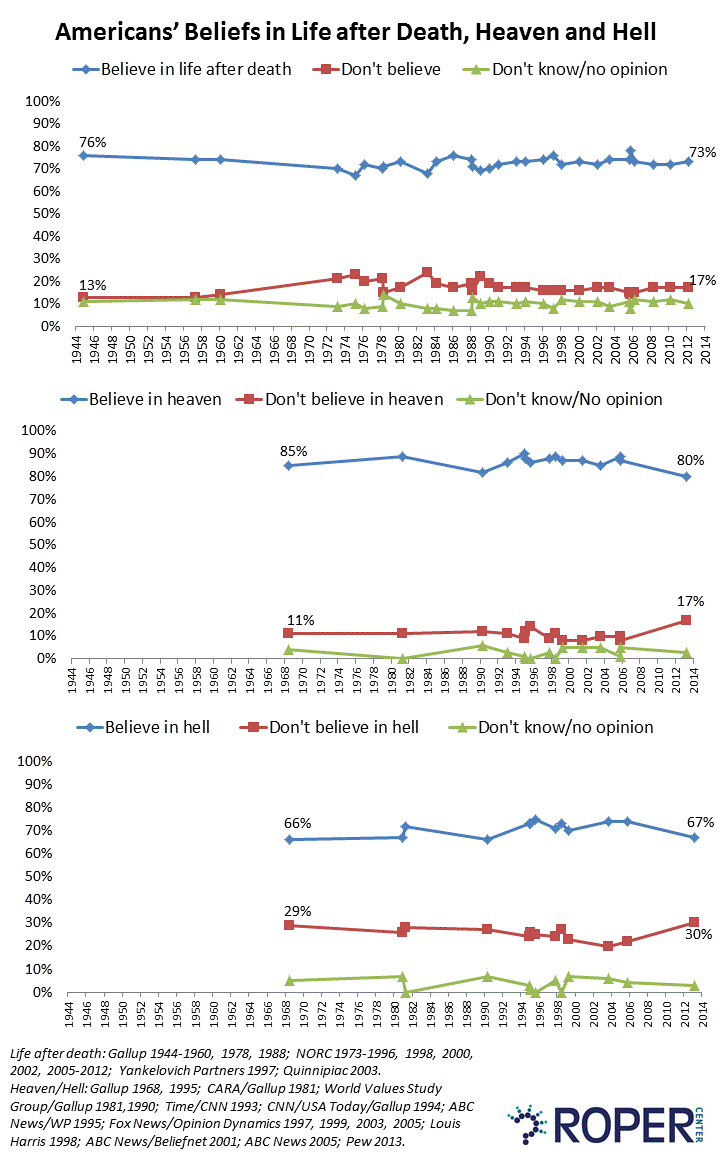
A large majority of Americans believe in life after death, though the specifics of their beliefs varies considerably.   Somewhere between about 70% and 90% of Americans believe in some kind of life after death.  Only a small minority of Americans do not believe in an afterlife.  There is wide divergence of belief in the details of life after death, with a number of inconsistencies in the range of beliefs about immortality. 

Most Americans (about 80%) believe in Heaven.   Curiously, according to one survey, a higher percentage believe in Heaven than those who believe in life after death.  A smaller number (about 60%) believe in both Heaven and Hell.  A minority group believes that a person exists after death and lives on in a spiritual form in another dimension, but not heaven or hell.  About 50% of Americans believe in ghosts here on earth.  About 20% believe in reincarnation.  There is considerable overlap among individuals’ various beliefs about the afterlife, whether about heaven, hell, a separate spiritual existence, ghosts, reincarnation, or some combination of these.

Dante: Inferno, Purgatory, and Heaven
The Divine Comedy, an epic poem written by Dante Alighieri (1265 – 1321), set much of the popular imagery about heaven and hell.  The poem tells of an allegorical journey through hell, purgatory and heaven, as guided by the Roman poet Virgil, and Dante’s life-love, Beatrice.  Each realm of the afterlife is divided into ten circles, representing gradations of sin, circumstance, and merit.  The construct is an attempt to render the afterlife comprehensible from the standpoint of justice.  The simple duality of damnation and paradise is too stark and simple as judgment for the complexity of human experience.  Thus, the souls of pre-Christian philosophers and babies who died before baptism were sent to limbo, in purgatory, according to tradition. 
Illustration of Hell from the 11th century manuscript Hortus Deliciarum (Garden of Delights).

The Christian View of Heaven and Hell
The remainder of this post will focus on the mainstream American Christian belief in Heaven and Hell as destinations in the afterlife.

Jesus will come again with glory to judge the living and the dead.
                                                                -- Nicene Creed
He ascended into heaven, and sits at the right hand of God the Father Almighty:
From thence he shall come to judge the quick and the dead.
                                                                -- Apostles’ Creed

It is interesting to note that in the language of the creeds, judgment does not occur at the moment of death, but happens later, at the second coming of Christ.  This is contrary to a common belief about the immediate disposition of the soul at the time of death. 

The ideas of Heaven and Hell are cornerstones of traditional Christian belief.  These beliefs are directly rooted in the teachings of Christ.   In the Parable of the Sheep and Goats, Jesus says that people who ignore the needs of the poor are cursed, and will be thrown “into the eternal fire prepared for the devil and his angels”.  Jesus also spoke directly of heaven, saying to one of the thieves crucified with him, “Today you will be with me in Paradise”.

The fundamental question here is whether the concepts of heaven and hell pass the test of reason.  Why do we briefly live on earth, if we are to exist for eternity after we die?   And if existence has such an asymmetrical duration, why did God create the realms of life and death? 


Heaven
The Heaven of the Old Testament is quite different than the Heaven of the New Testament.  The Old Testament (Genesis, Daniel, Nehemiah, Kings, Ezekiel, Exodus, Psalms) describes Heaven as the skies above, and the place where God and angels dwell.  Except for Elijah, who was specifically chosen to rise to heaven, it is not described as a place where humans go after death. 

Heaven in the New Testament is quite different.  Jesus speaks often of heaven, of God the Father in Heaven, and of the Kingdom of God in Heaven.  Jesus tells his disciples that they can aspire to Heaven, although he cautions that rising to heaven is not easy.  Jesus says that unless his followers are more righteous than the Pharisees and teachers of the law, they will not enter Heaven (Matthew 5:20), and says that it is easier for a camel to pass through the eye of a needle than for a rich man to enter the Kingdom of God (Matthew 19:24).   

Gustave Dore, Paradise, 1892

But what is heaven, when we get past the cartoons of popular culture -- the pearly gates of Saint Peter and the white-winged angels standing on puffy clouds and holding harps.  What would eternal life be like?  What would it be like after one hundred years?  After the first million years?   After the first billion years?  After the hundredth billion years?  Would any aspect of the human personality persist over such lengths of time?  What is the meaning of eternal life, as promised by Jesus Christ? 

We’ve previously considered the qualities of the human soul, as expressions of the human self: memory, will, self-awareness, thoughts and emotions.  How could these persist for a billion years?  What would remain after these things fade?  Why did God create the realms of life and death, if life in Heaven resembles life on earth?  What does the survival of the soul mean if life in Heaven is different for eternity?  We might consider that the human soul could transform into something else, into a higher kind of being, but for what purpose?  Certainly, whatever might remain after a billion years would no longer be human.  What would such a being do?  What would it think?  Why would it exist, and why would it have begun its existence as a mortal human life? 

Hell
Our idea of Hell as a place of fire and torment is drawn directly from the Bible and the words of Jesus.  It is also clear from the words of Jesus that heaven is reserved for only the exceptional few, the most worthy in the sight of God.   What, then, happens to the rest?  By default, they are consigned to hell, or the middling realm of purgatory, as described by Dante in 1320.

Purgatory, Gustave Dore
Theologians and others have spent considerable mental energy in trying to rationalize the justice implicit in consignment to Hell.  Dante’s Inferno is typical of these rationalizations, where different levels of Hell are allocated according to differing levels of sin.  (I have not read Dante, to my regret.)  For example, pre-Christian philosophers such as Socrates was assigned to the relative comfort of the first circle of Hell, because they lived their lives with honor, virtue and integrity, but were not given the opportunity for baptism or salvation.  Dante’s vision of Hell continues in incremental fashion through moderate levels of torment to the deepest levels, reserved for the greatest sins.   Botticelli’s painting of Hell follows this pattern, with the caverns of hell connected vertically by staircases.  Tormented souls lie prostrate along the halls, and the dungeons become smaller with depth.  [The model implies a skewed statistical distribution of wickedness, with relatively mild sinners greatly outnumbering deeply evil human souls.  The model is intuitively correct.]
The Map of Hell, Botticelli, circa 1480 -1490.

But there is limited fairness in this.  Why did God design a world where honorable men had no opportunity for salvation, simply because Christ arrived too late?  

Calvinists take this idea to a horrifying level based on the presumed omniscience of God.  In the Calvinist view, each soul is predestined at conception for either salvation or damnation.  Indeed, since all is known, each soul is predestined for heaven or hell at the beginning of creation.   What kind of justice is this?   What kind of God would call souls into existence, knowing they are doomed for eternal torment and suffering?  What does this say about free will of humans, individual morality and judgment?  What does this say about the goodness of God?  I am reminded of a scene from Disney’s “Fantasia”, during the piece by Mussorgsky, “Night on Bald Mountain”.  The Ukrainian demon Chernobog (literally “Black God”, representing Satan) conjures a handful of flames into beautiful flaming dancing women.   He then torments them through several transformations, each uglier than the last.  Finally, bored with his game, he crushes them out of existence in his fist.   What is the difference between this and the Calvinist view of God, except that the Chernobog eventually ends the torment of his victims, and the Calvinist God torments his created souls for all of eternity?

Summary
What kind of God would construct hell?  Do the ideas of Heaven and Hell pass the tests of reason and justice?

An Eskimo hunter asked the local missionary priest, 'If I did not know about God and sin, would I go to hell?'
'No,' said the priest, 'not if you did not know.'
'Then why,' asked the Eskimo earnestly, 'did you tell me?'

We tend to rationalize our visions of divine judgment by constructing models which meet our standards of reason and justice.  Thus, we have Dante’s concentric circles of Hell, with degrees of punishment aligned to degrees of sin.  We have the vision of Saint Peter at the Pearly Gates, checking his list like a bouncer at an exclusive nightclub.  But what basis do we have for imagining reward or punishment?   We have scripture, scripture contains none of the detail which is needed to answer questions of justice.  Further, Judeo-Christian scripture is only one of 3000 competing visions of what divine justice means.   We also have our human instinct for fairness, which we share with many higher creatures.   But to construct models of judgment which meet our standards of reason and justice, and then justify those models based on our instinct for sense and fairness is circular reasoning. 

The idea of Hell fails the standard of justice, because the punishment of eternal torment is disproportionate to any conceivable sin.  The idea of hell is also incompatible with the idea of a good and loving God.  Christians who embrace the idea of a loving God must logically reject the idea of eternal damnation, torment and suffering.  Eternal torment is an asymmetric and unjustified punishment for any temporal sin.  And yet we have no basis for ameliorating the model, simply to satisfy our desire for fairness.  The idea either meets the standard of justice, or not.  And it doesn’t.  Either God is not a loving God, or there is no hell.
William Blake, The Book of Urizen

The idea of Heaven fails the standard of reason.  The immortal existence of the soul, extending into infinite time as a coda to our brief lives, also has an illogical asymmetry.  Why is life in the material world so brief, if the soul lives in Heaven so long?   I have a lot of things to do.  There are a lot of things I should do, but I lack the lifetimes to do what needs to be done.  And I could pass eternity in Heaven with a harp, but that will not allow me to take care of real problems here on earth.  A loving and omniscient God working with intelligent design would have given me a little more time on earth and a little less time in Heaven.

Judging God, rather than being judged, is a revolutionary idea.  I freely admit I stole the idea from physicist David Deutsch, in the book “The Beginning of Infinity”, which I highly recommend.  As reasoning beings, we are obligated to judge God (and our beliefs) according to the standards of reason, justice and goodness.   Belief in Heaven fails the standard of reason.  Belief in Hell fails the standards of reason, justice, and the goodness of God.  A reasoning person must reject these beliefs. 
--
Illustrations:


References:
Elizabeth Cotten (1893-1987), grandchild of American slaves, was self-taught on guitar and became a recognized folk artist in her 60s.  Cotton composed “Freight Train” at the age of 11, performed it in public for the first time at the age of 67, and won a Grammy award for the song at the age of 93.
Like many folk songs from 1850 - 1900, the song is an allegory of death, represented as a train.  


Saturday, October 29, 2016

God as Sustainer of All Things

In the book The Beginning of Infinity, physicist David Deutsch imagines the following dialogue between the philosopher Socrates and the Greek God Hermes:

Hermes, speaking to Socrates: “How many [Athenians] are willing to criticize a god by the standards of reason and justice?”
Socrates, [ponders]: “All who are just, I suppose.  For how can anyone be just if he follows a god of whose moral rightness he is not persuaded?  And how is it possible to be persuaded of someone’s moral rightness without first forming a view about which qualities are morally right?”
“A Dream of Socrates”, in The Beginning of Infinity, by David Deutsch, 2011
The dialogue was drawn from themes in Plato's "Apology", the account of Socrates' self-defense in his trial for impiety and corruption of the youth.

In the traditional Christian view of God, God is creator of all things, sustainer of all things, and judge of all people.  From Scripture, particularly John 1:3, we learn that nothing was made without God; nothing exists without God.  God is in all things, rules all things, determines all things.  In this post we will consider the role of God the sustainer of the world. 

I recently attended a session of Alaska’s excellent story-telling forum, Arctic Entries.  The monthly programs allow people in the community to tell stories of their lives.  In the most recent show, a story-teller told of an improbable and horrific accident.  While swimming in a lake with other young people, a rope from a boat somehow became wrapped around his neck, just as the boat departed at high speed.  The young man survived, but suffered a stroke which left half of his body paralyzed.  The young man was a church leader in a mentoring program for high-school students; he had given of his time and wisdom to make their lives better.  So why, of the eleven people on stage, was he the one to suffer a physically and mentally crushing random injury?  Where is the God who is in all things, determines all things, and rules all things?

If we take David Deutsch’s dialogue of Socrates to heart, we are not only permitted, but obligated to question God’s performance as the sustainer of all things, according to rational standards of justice and goodness.
God the Father, Julius Schnorr, 1860

Making Excuses for God -- When Bad Things Happen to Good People
Everybody knows that bad things happen to good people.  Theologians and religious people acknowledge that this is one of the most difficult issues with faith.  There is a huge volume of religious literature dedicated to the topic of explaining the injustices of life to those who have suffered pain, injury, and tragedy.  The literature tries to help people make sense of their loss, to reconcile the evil they have suffered with the fundamental goodness of God. 

People make excuses for God.  When bad things happen, people can always provide an explanation.  Here is a short sampling of the excuses I have heard for why God allows suffering to exist.  I have taken many of these verbatim from religious websites; others I remembered from sermons and teachings from childhood.  The essence of these excuses is that bad things happen, but it is never God’s fault.
  • God has a higher purpose.
  • God is testing our faith.
  • God is not responsible for all the evil that is happening around us; Satan is. 
  • People are wicked.  The innocent suffer, along with the wicked.
  • God always answers your prayers, just not always in the way that you want.
  • God allows suffering because troubles make you stronger.
  • God allows suffering because people have been granted free will.  Other peoples’ sins and decisions cause the innocent to suffer, but it isn’t God’s fault.
  • Good people suffer on Earth, because the reward is in Heaven. 
  • God wants the loved one in Heaven.
  • Suffering in this world doesn’t matter, because eternity makes the difference.
  • Pain awakens us to God.
  • If we understood why innocents suffer, we would be unmoved, and that would be unthinkable.
  • God is able to restore the life of the child, so from God’s perspective, there’s no loss.
  • All people have sinned, and people share the sins of others, so there are no good people.
  • God allows bad things to happen to good people to teach them lessons, to discipline them, to improve their character, to encourage them to depend on him, etc.
  • God did not create people to suffer, but sometimes we do suffer because we live in a fallen world.
  • Evil entered the world when Adam and Eve disobeyed God.  We live with suffering as a consequence of their disobedience.
  • Trust in God; God knows what he is doing.
The sheer number and variety of excuses for God suggest to me that there is no appropriate answer for God’s apparent indifference to human suffering.

If we continue along the path suggested by David Deutsch, we should question God according to the standards of reason and justice.  It is easy to frame responses to each excuse for God’s indifference, as follows:
  • Is God, the omnipotent, unable to accomplish his higher purpose without causing suffering?
  • Is God unable to differentiate the good from the bad, and treat each accordingly?
  • Why does the reward in Heaven require suffering on Earth?
  • What kind of kindness is represented by testing humans with cruelty?
  • God has all of eternity; if he wants somebody in Heaven, why can’t he wait?
  • If a prayer is for mercy and goodness, why would it be denied?
  • Why is it necessary to cause suffering in order to teach someone?
  • What kind of relationship relies on punishment to enforce loyalty and obedience?
  • Why should anyone suffer for the sins of others?
Despite promises in the Bible and liturgy, God doesn’t intervene to provide justice in human affairs.  As I have done in other posts on this blog, I could provide examples; lists of injustices in human experience.  But that is unnecessary.  For every article about faith repaid by divine intervention in Guidepost magazine, everyone knows there are innumerable examples of undeserved tragedy, throughout history.  Many of those tragedies are of human doing, but many are natural disasters – in legal parlance, Acts of God.  And if natural disasters inflicted on the innocent are in fact, acts of God, should we not judge God according to the standards of reason and justice?

Mercy is innate, through-going and consistent behavior.  God’s mercy should not be capricious or biased, threatening or conditional.  We should criticize God according to the standards of reason and justice when we consider the problem of suffering in the world.

When Good Things Happen to Bad People
Good things also happen to bad people.  This is the converse of the usual paradox, although it is examined less often.  In fact, we know that good things happen to all kinds of people, and bad things happen to all kinds of people.  Throughout history, the innocent and good have suffered equally with the wicked; the wicked have prospered as much as the deserving and just.  It’s pretty clear that ethical or moral merit just doesn’t matter when it comes to cancer, debilitating illness, and early death.  And wicked leaders such as Ivan the Terrible, Josef Stalin, Robert Mugabe, Muammar Gaddafi, Idi Amin and others survive and prosper, unless brought down by the concerted efforts of men, not God.

Conclusion
In the course of writing this post, I realized that Hans Christian Anderson’s story “The Emperor’s New Clothes” is perhaps about religion.  People generally believe what they are told by a person of authority.  When people are taught from birth, they will fiercely believe in those things despite evidence from their own experiences and senses.  In Anderson’s story, only a child could acknowledge what was plainly seen by all – that there was nothing there. 

People stubbornly hang on to what we were taught as children.  Some people who were taught that Pluto is a planet are deeply distressed by the scientific re-classification which changes that status.  People are taught to trust in God, as they trust in their parents.  Some psychologists even say that that we are pre-wired to believe in God.  And so, people retain their belief in God, regardless of their life experiences, and regardless of how contradictory those experiences may be compared to the teachings about God from childhood.  Gaining release from those beliefs requires critical, objective thought, contrary to some of our earliest instruction.  It isn’t easy.

Human experience is incompatible with the traditional concept of God – omniscient, omnipotent, infinitely good, Creator and Sustainer of the world and mankind.  The suffering which mankind endures is simply incompatible with such a God.  God, if he exists, is either not infinitely good, not infinitely powerful, or not interested in mankind.

---
References:
David Deutsch, 2011, "A Dream of Socrates", pp. 223 - 257, in The Beginning of Infinity, p.496.
Plato, Apology, c. 399 BC.  (Apology is Plato's account of Socrates' speech at his trial for heresy and corruption of the youth.  The trial ended in Socrates death sentence, which was carried out some months later.  In my view, Socrates was approaching the idea of monotheism, and used the term "the god", whenever he spoke of his own faith.), in Plato, Five Dialogues, translated by G. Grube and J. Cooper.
The Bible, John, 1:3.