Showing posts with label Christianity. Show all posts

Friday, May 8, 2026

The Transactional Primate and Transactional God

This post examines the transactional nature of people, and our presumption of transactions with unseen gods and spirits.  One of the presumed transactions is the biblical sacrifice of Jesus Christ in exchange for the forgiveness of human sins.  The post asks why a loving god would require a transaction involving a blood sacrifice rather than granting unconditional forgiveness to humanity.

This image of the crucifixion site was generated by AI.

Some animals understand transactional relationships.  Crows are well-known for transactional behaviors, bringing shiny objects in response to being fed.  There’s a delightful, documented story of a squirrel which spontaneously began stealing cookies and bringing them to someone who had been feeding the squirrel.  Animals can have a sense of gratitude and empathy, presume that something is valuable and giving it in trade for benefits received.  But an animal’s sense of what is valuable may differ from what humans appreciate, as cat owners who find a dead mouse on their pillow can attest.

Humans are among those animals with a natural capacity to understand trade.  Humans have the most complex social lives in the animal kingdom.  We have the ability to communicate, understand, and participate in exchanges.   Transactions are a necessary part of human social behavior, well illustrated in pop-psychology books Games People Play and I’m Okay, You’re Okay.  The books are correct that transactions are among our core social behaviors, and are necessary in society.  We are transactional creatures by default.  

Transactional Programming
Our faith in transactional fairness is borne out our daily experiences.  Over-indulgence often carries negative consequences, and self-denial often conveys benefits.  Sweets and fatty foods cause tooth decay and unwanted weight gain, and perhaps more serious consequences of diabetes, high blood pressure and heart disease.  Exercise requires a cost of time and effort but produces health benefits.  Working hard may result in a promotion or more pay; saving money usually results in more money later.  Going out of our way to help someone may result in a new friendship, a reciprocated favor, or simply the pleasure of doing a good deed.  Time spent in picking up, cleaning, personal hygiene, seeing the doctor and dentist all have an immediate personal cost, but we expect a better quality of life in those transactions.

We are so programmed to expect fair transactions that we often fail to verify that a transaction yields a benefit.  We expect that a large package will be a bargain without checking the unit price.  Or we choose an expensive product, presuming that the cheaper option is of lower quality.  We usually assume that what is easily obtained is less valuable than something that requires more effort and personal cost, without requiring proof.

Religious Transactions
Humans apparently conducted transactions with spirits for as long as we’ve had the unique quality of being human.  All cultures offered prayers, worship and sacrifices to invisible, unresponsive spirits in exchange for presumed material benefits, either in this life or the next.  Sacrifices included food and drink, coins and jewelry, animals and human lives.  James Michener writes that as Polynesian cultures struggled with priests representing competing gods, it was presumed that the gods which demanded the most extreme sacrifices must be the strongest gods.  So the culture adopted more extreme practices of human sacrifice to appeal to the strongest god.  It is incredible that cultures throughout history participated in sacrificial transactions without ever requiring an audit to verify that promised material benefits were actually delivered.

The Judeo-Christian religion anthropomorphizes God and presumes that God wants things that humans want – praise, faithfulness, obedience, trust, conversation, connection and love.  But our religious leaders never ponder the question of why God would want those things.  Does God really want our worship and offerings, any more than we want the dead mouse generously given to us by the cat?  Why would God care about praise from humans any more than the praise from flatworms?  What good is human worship to the creator of two trillion galaxies?

In the movie “Men in Black”, miniature aliens living in a locker in Grand Central Station worship Agent Jay in a transaction for his gift of a wristwatch, to Agent Jay’s annoyance.

I previously wrote a brief post about the transactional nature of God in the Old Testament, here: https://sensibledisbelief.blogspot.com/2017/10/the-old-testament-rarely-heard-bible_29.html.

Sacrifice is featured prominently in Old and New Testament Judaism.  Second Chronicles 4-5 details the sacrifices to God offered by King Solomon for the dedication of Solomon’s temple, including 22,000 cattle and 120,000 sheep, plus offerings of grain mentioned a little later.  Nearly 1000 years later, sacrifices of animals was still a central part of Jewish religious observance, with the Gospels noting sacrifices of doves, pigeons, oxen, and sheep in ordinary worship. 

Some religions represent that the reward for transactions with spirits is not in this life but the next, removing the need to prove that benefits are received through the religious transaction.  This requires several levels of unfounded assumptions.  The first assumption is that unseen spirits exist.  The second assumption is that there is a life after death in some place, in some way that has meaning to a human individual.  The third is that unseen spirits desire what is sacrificed by humans, and fourth, that unseen spirits have agency over outcomes in the afterlife.  It’s hard for me to decide which of these is the most preposterous.  

Human Sacrifice
Judaism was one of the first religions to eschew human sacrifice.  Genesis 22 tells of God’s command to Abraham to sacrifice his son Isaac.  Abraham obediently prepares for the sacrifice, but before he can complete the act, God intervenes in the form of an angel, providing a ram to be killed in place of the son.  This sets a precedent for Judaism and later Christianity, that human sacrifice is not a transaction desired by God.  

Historian Thomas Cahill claims that every human culture practiced human sacrifice before the arrival of Christianity (Cahill ignores two millennia of Jewish precedent before Christianity in rejecting human sacrifice.)   It’s good that religions eventually recognized the immorality of such practices and brought them nearly to an end in the modern world.  Perhaps there is a slow improvement in human behavior, as Steven Pinker argued in “The Better Angels of Our Nature”.  The topic of human sacrifice is broad enough that it deserves a separate post.  

But in the general rejection of human sacrifice in Christianity, there is one striking exception.  It is the central tenet of Christianity - the transactional sacrifice of the life of Jesus Christ in payment for the sins of humanity.  

Sacrifice of Christ
It’s clear from scripture that the crucifixion of Christ is a transaction.  The death of Jesus is a payment demanded by God in exchange for the forgiveness of human sins.  This is the central tenet of Christianity.  The transaction is explained clearly in the prophecy of Isaiah, in the last supper in the gospels of Luke and Matthew, in the first letter of Paul to the Corinthians, and in the Apostles’ Creed.   It somehow matters to God that blood must be shed to earn divine forgiveness for the sins of humanity.  For an ineffable reason, unconditional forgiveness of human sin is just not in God’s rule book.  Like the pagan gods of old, the Christian God demanded a blood sacrifice.

We’re told that Jesus is God’s only son.  Among two trillion galaxies, each with hundreds of billions of planets, God chose to place his son here on Earth, with the expectation that Jesus would be tortured and killed to complete the necessary transaction for the eternal salvation of humanity.  God brought his mortal son Jesus to teach mercy and forgiveness to humanity, but the transaction here seems contradictory to the message.  

I think it’s important for us to ask why God would do any of that.  Why would God demand the life of Jesus in a transaction to forgive human sins, when God created humans to be inherently sinful?  Why does God not grant unconditional forgiveness to humanity, especially in the case of the teacher who taught forgiveness and to turn the other cheek?  Echoing Martin Luther, if God's grace is not freely given, is it really grace?  At what point do religious teachings strain our credulity to the breaking point?  When does a reasonable person say aloud “This doesn’t make any sense.  It cannot be true.”? 

Conclusion
Humans are transactional creatures by nature.  Our life experiences program us to expect transactional exchanges with nature and with other humans.  People project their transactional expectations onto the unseen spirit world, with no evidence that the spirit world exists or responds to the traces offered by people.  

In the Christian religion, doctrine teaches that the life of Jesus Christ was exchanged for the forgiveness of humanity’s sins.  This transaction is the central tenet of the religion.  Christians should question why God demanded this exchange, which runs counter to the idea of divine grace and unconditional forgiveness.  
It doesn’t make any sense.


Wednesday, December 10, 2025

The Halo Effect

 Why do sensible, educated people believe in God?  

As I explored previously in this blog, belief in God involves acceptance of logical paradoxes, disregard for the lived experience of other people, and belief without reasonable evidence.  So what is the motivation for belief?  

One answer is that belief in God is the cultural norm.  Most nations have a dominant religion, and that religion permeates society and culture.  So there are Protestant Christian, Catholic, Orthodox Christian, Shia Muslim, Sunni Muslim, Hindu, Buddhist, Jewish and other religions, each with its own diversity of sects, which each dominate a culture.  People are also taught the precepts of religion from childhood.  It is easiest to simply believe and observe the rituals than to intellectually challenge the medium surrounding us all.  

Another motivation for belief is hope in the midst of despair.  All people, at some time, experience disappointment in life, defeat, discouragement and depression.  Some people have lived in situations utterly without hope; others may experience an internalized feeling of despair.  In either case, religion can be a source of hope and I would not want to take that away.  

But for those who would live their lives by a standard of truth, and are able to withstand the vagaries of life without reliance on religion, I expect that more of them would reject religion.  In western cultures, particularly in America, we have a culture of questioning academic orthodoxy and dogma.  For educated people trained in critical thinking, why does religion receive a pass from rigorous skepticism?  

I think part of the answer is the halo effect.  

This image in the style of a Russian Orthodox icon was generated by AI, which is still unable to count fingers on a hand. 

The halo effect is a form of cognitive bias, one of dozens of common, repeatable human errors in perception or judgment.  These errors are explored in a number of popular psychology books, including Inevitable Illusions by M. Piattelli-Palmarini, Predictably Irrational, by Daniel Areily, Thinking, Fast and Slow, by Daniel Kahneman, Blink by Malcolm Gladwell, The Art of Thinking Clearly by Rolf Dobelli, Nudge by Richard Thaler, Fooled by Randomness by Nassim Taleb, etc.  Most of these cognitive biases reflect internal heuristics (rules of thumb) which people use to make rapid, simple judgments about complex things.  

The Halo Effect was first rigorously documented in 1920, by Edward Thorndike.  Thorndike defined the halo effect as a cognitive bias in which one facet of a person or thing affects judgment about other facets of that person or thing.  The usual example is that a person who is deemed to be attractive is also perceived, without evidence, as being smart, neat, diligent, well-behaved, friendly or other positive qualities.  

In the case of religion, I think that the positive aspects of religious doctrine lead people to conflate being *good* with being *true*.  

Certainly, there is much about religious doctrine that is objectively good.  Most religious teachings include some version of the Golden Rule. It is well represented by Jesus’ admonition to love your neighbor as yourself.  In general, the Christian New Testament reflects core human values of goodness, including kindness, empathy, forgiveness, fairness, justice, service and responsibility.  There are also teachings of gender inequality and intolerance, which are considered negative in modern values, but predominantly, the New Testament is an instruction to be good.  It is much like the departing words of the alien in Steven Spielberg’s Christ-like story, "ET":  “Be good.”

But one critical value is missing from the human values represented in the New Testament, the value of Truth.  In any prioritization of human values, Truth should be one of the highest values, exceeded only by kindness. **

My grandfather spent a number of years as a missionary in Japan, running a Christian bookstore and teaching English at a Christian boys’ school, while raising his family.  He believed that mission work should first address the physical needs of people for food, shelter and economic development, then education, then fellowship, before broaching the ideas of the Christian religion.  He believed that living the example of a good life was the best way to bring about conversion to Christianity.  After World War II, he was the founding director of the Methodist Committee on Overseas Relief, and later was director of the World Council of Churches’ world literacy program.  By objective criteria, he was a good man, and lived a good life.  But living a good life doesn’t make his religion true.

One of my friends argues that on balance, the force of religion for good outweighs any question of whether or not it is true.  It is depressingly true that there is evil in the world, and evil behavior by people of all cultures.  Perhaps some of those people could be influenced by either the teachings of Jesus, or the prospect of eternal damnation for their deeds.  But the persistence of evil despite the prevalence of religion gives me doubt.*

On balance, the influence of religion for good does not offset the fact that it isn’t true
.  I think that a false belief in God will ultimately lead to greater evil, as it has so many times in the past.  

In the long run, you cannot reason to sound conclusions from false premises.  Belief in something that isn’t true, will eventually lead to conflict with others who hold conflicting absolute beliefs.   This is especially true for belief in an all-powerful god and in god’s absolute truth.

In writing the American Declaration of Independence, Thomas Jefferson and Benjamin Franklin wrote of the self-evident truths of inalienable human rights.  It was John Adams who inserted the line “endowed by their creator”.  I suggest that human morality should be derived along the thinking of Jefferson and Franklin, as a self-evident truth that people should be good, according to core human values, without the need for instructions from a god that doesn’t exist.  
--
Appendix
*  Donald Trump recently mused aloud that his chances of getting into heaven were small, but perhaps he could tip the scales by winning the Nobel Peace Prize.  That isn’t my notion of how the scales of heavenly grace would work, but whatever.  

But just as the Christian religion urges people to be good, it offers a Get Out of Hell Free card through repentance and forgiveness.  Evildoers through the ages have relied on the idea of heavenly forgiveness while perpetrating heinous crimes against humanity.  In the time of Martin Luther, the Catholic church sold "indulgences", which were pre-approved forgiveness tokens for planned or completed sins.  Religious people banking on divine forgiveness span the spectrum from Ivan The Terrible (who tortured thousands, murdered his son and then prayed for forgiveness) to fundamentalist Christian pedophile ministers to decamillionaire televangelists.  These Christian faithful sinners are either banking on  heavenly forgiveness or are secretly complete atheists.  I’m inclined to think that they believe that they can game the system with late-life repentance.  It is hard for me to understand exactly what these people believe, given the deep hypocrisy between their public religious exhortations and their private behavior.

**In an attempt to restore truth to the New Testament and exclude superstition, Thomas Jefferson constructed a manuscript of the teachings of Jesus.  Jefferson collected text from the four gospels, but excluded all miracles, mention of the supernatural, the divinity of Jesus and the resurrection.  Jefferson called his final manuscript "The Life and Morals of Jesus of Nazareth".  It was first published in 1904.   

Sunday, February 25, 2024

What is Truth?

 Have you ever walked into the midst of a heated argument, and thought, “Wait; you’re both wrong!!”  I have that feeling when reading one of the iconic scenes of the Bible, the questioning of Jesus Christ by Pontius Pilate.  Pilate was the Roman prefect and governor of Judea.  Let’s review the conversation as reported in the gospel of John.  (Keep in mind that the gospel of John was probably maintained by oral tradition for at least 35 years, and did not reach final form until about 70 years after Jesus’ crucifixion.  The conversation may not reflect historical accuracy.)

“36 Jesus said, ‘My kingdom is not of this world. If it were, my servants would fight to prevent my arrest by the Jewish leaders. But now my kingdom is from another place.’
37 ‘You are a king, then!’ said Pilate.
Jesus answered, ‘You say that I am a king. In fact, the reason I was born and came into the world is to testify to the truth. Everyone on the side of truth listens to me.’
38 ‘What is truth?’ retorted Pilate. With this he went out again to the Jews gathered there and said, ‘I find no basis for a charge against him.’”

                            John 18:36-38, New International Version


"What is Truth?"  Jesus Christ and Pontius Pilate
Image credit unknown.

Jesus brushes aside the accusation of being an earthly king, and instead asserts that his entire mission is to testify to truth.  The gospels tell us that the truth Jesus preached is the reality of God, the necessity of worshiping God, the importance of loving neighbors, even neighbors you dislike, the importance of humility and forgiveness, the importance of renouncing worldly obligations (including family obligations) to follow him, the reward in the afterlife for worshiping God, and punishment in the afterlife for rejecting God.

But what if God isn’t real?  What if it is all a lie?  This seems to be the question that Pilate is asking, when he says “What is truth?”  Pilate doesn’t stay around for an answer to his rhetorical question.  I would read into Pilate’s question a rejection of the idea of truth, or a belief in relative truth, dependent on circumstances.  Let’s deal with Pilate first.

Pontius Pilate
Religion in the Roman empire of 33 AD was complicated.  Roman society was polytheistic.  Roman gods and goddesses had parallels in Greek religion (I will call these beliefs religion, rather than mythology.  People of the time regarded their gods as real as Christians regard their God today.)  Egypt had its own gods and goddess of quasi-human character, and there were a number of Levantine religions in addition to Judaism.  Further complicating the divine roster were ruler-gods.  Ancient Rome was surrounded by cultures which venerated their rulers as gods.  Egypt is the most well-known example of divine rulers, with pharaohs regarded as divine intermediaries between gods and humans.  First Greeks and then Romans adopted the practice of deifying rulers after death.  We can’t know what Pilate thought of these conflicting religious ideas, or if he was a true believer in Mars, Zeus, or the emperor Augustus as real divine gods.  The rhetorical question “What is truth?” suggests that he regarded Jesus’ god as no better and no worse than the rest.

But regardless of uncertainties, we cannot disavow truth.  Logic falls apart if we cannot say that any proposition is true.  Mathematics disintegrates if we cannot firmly assert that 2 + 2 equals 4.  There is no corner of time or space in which 2 + 2 does not equal four.  Even in relativistic physics, the resting mass of an object is constant.  Truth is absolute.

Like Goedel’s theorem in math, truth is also necessarily incomplete.  We will never know the full truth about many things.  Also, some aspects of physical reality, like quantum mechanics, are subject to probabilistic rules.  But these probabilistic rules are themselves truth over the domains where they apply.  Further research will undoubtedly produce new fundamental discoveries and overturn current knowledge, but this does not invalidate the idea that truth exists.  Do not confuse knowledge and truth.  Knowledge is necessarily incomplete and imperfect.  Truth, which we may only approach, is absolute, whatever it is.

I cannot resist a tangential mention of a brilliant essay by Isaac Asimov, The Relativity of Wrong, published in Fantasy and Science Fiction in 1986, and in a collection of non-fiction essays in 1988, under the same title.  While truth is absolute, there are degrees of falsehood.  The statement 2+2=5 may be false, but it is less false than 2+2 =5,492,817, which is less false than 2+2=purple.

We recognize different degrees of certainty in determining truth in different settings.  In the courtroom, the preponderance of evidence (i.e. >50%) is sufficient to determine truth in a civil case, but evidence beyond a reasonable doubt is necessary for a criminal conviction.  Similarly, in science, different levels of certainty are assigned to scientific findings, with the ultimate determination of "unequivocal" for the highest level of certainty.  In this essay, I am searching for truth beyond a reasonable doubt, or unequivocal truth.  These are criteria where objections to the finding are not based on reasonable evidence, or opposing arguments which are not in good faith.

Jesus
Our discussion of Jesus begins with another iconic passage from the gospels.
“Thomas said to him, ‘Lord, we don’t know where you are going, so how can we know the way?’
Jesus answered, ‘I am the way and the truth and the life. No one comes to the Father except through me.’”
                    
John 14:5-6, New International Version.

In his statement to Pilate, Jesus said that he came into the world to testify to the truth.  In his statement to Thomas, Jesus said that he embodied truth, as well as the unique and only path to God.  Remember that claim as we consider statements from a number of other religions.

Jesus taught that he was the prophesied messiah, that God was real, and that there exists a kingdom of heaven which only believers can reach.  Jesus taught that devotion to God and Jesus was necessary for salvation from sin and eternal life in the kingdom of heaven.  There were many other teachings involving empathy, equality, forgiveness, and human relationships, but Jesus’ core message was about religion and the human relationship to God.  But how do we know that Jesus’ testimony is, in fact, the truth?  There are many claims to be the one true religion on Earth.

"The Christian religion is true, because it has pleased God, who alone can be the judge in this matter, to affirm it to be the true religion· And it alone has the commission and the authority to be a missionary religion, i.e., to confront the world of religions as the one true religion, with absolute self-confidence to invite and challenge it to abandon its ways and to start on the Christian way."
                         ― Theologian Karl Barth (1886-1968).

“The Bible clearly states that repentance and faith in Jesus Christ is the only way to receive salvation. And that's how we can know that Christianity is indeed the one true religion.”
                        
United Church of Christ Webpage


The Truth of Shintō is to be seen in the inevitability of its underlying doctrine.  This is apparent on consideration of the real significance of the great deities introduced in the oldest Yamato literature….This is the Truth of the Way of the Gods.
                        ― Kazusaku Kanzaki, Shintō Honkyoku no Kyōri ("The Doctrine of Shintō Honkyoku"), Uchü ("The Universe"), (January 1930).  [Complete quote and list of gods given below.]

“It is our firm conviction that The Church of Jesus Christ of Latter-day Saints is, as the revelations state, ‘the only true and living church upon the face of the whole earth.’”

                        ― Elder Boyd K. Packer of the Quorum of the Twelve Apostles, 1985, on the webpage of the Church of Jesus Christ of Latter Day Saints, "The Only True Church".

"30 And also those to whom these commandments were given, might have power to lay the foundation of this church, and to bring it forth out of obscurity and out of darkness, the only true and living church upon the face of the whole earth, with which I, the Lord, am well pleased."
                        ― Doctrine and Covenants 1:30, 1835  (Church of Latter Day Saints).

“If I were asked to define the Hindu creed, I should simply say: Search after truth through non-violent means. A man may not believe in God and still call himself a Hindu. Hinduism is a relentless pursuit after truth... Hinduism is the religion of truth. Truth is God. Denial of God we have known. Denial of truth we have not known.”
                        ― Mahatma Gandhi

There is only one God, and It is called the truth, It exists in all creation, and It has no fear, It does not hate, and It is timeless, universal and self-existent! You will come to know it through the grace of the Guru.
                        ― Sri Guru Granth Sahib, Holy Scripture of Sikhism, circa 1604.

“‘Once that has been made clear, we can easily say that Allah sent only one form of legislation for all of mankind to follow, otherwise if we were to say that there is more than one then that would entail that Allah is unjust because He left us to wander about on earth without showing us the right way to do things, and this is impossible because Allah is Just.  Therefore the only logical conclusion is that there is only one true religion, which contains guidance in all spheres of life, and that all other religions are false.”
                           ― Kamil Ahmad, current webpage.

“He who upholds Truth with all the might of his power, He who upholds Truth the utmost in his word and deed, He, indeed, is Thy most valued helper, O Mazda Ahura!”
“Truth is best (of all that is) good. As desired, what is being desired is truth for him who (represents) the best truth. (Gathas 27.14)”

                            ― Zarathustra, circa 1000 BCE

There are approximately 3000 to 4000 different religious faiths and traditions known in historical times.  Most of these claim to be the one and only true religion, and the only path to know God, receive salvation, have happiness in the afterlife, etc.  A few religious traditions, like Unitarianism, accept all faiths, but this sweeps contradictions under the rug instead of rationally working toward an understanding based on truth.  Some of the intellectuals writing about religion come very close to the correct analysis, but fail at the end. 

Zacharias Ursinus, circa 1563 AD, wrote: “doctrine which contradicts itself can neither be true, nor from God, since truth is in perfect harmony with itself, and God cannot contradict himself.” 
And yet, despite obvious contradictions in doctrine, in the Bible, in the concept of God and the injustice in the world, Ursinus fails to conclude that religious doctrine is false, and God isn’t real.  He was so close.

Sometimes an Internet meme is the simplest way to convey an idea.  The claims by many religions to be the one true faith cannot possibly all be true.  Nor do relativistic equivalencies between different churches make sense.  While there are some similarities between religions, there are also deep and fundamental differences of doctrine and belief, from polytheism/monotheism, to creation stories, to religious commandments, etc.  These differences are real and irreconcilable.


Since Jesus declared that he embodied truth, the subsequent 2000 years have not provided any convincing evidence that God exists.  There is no evidence that prophecy is true, that spirits exist separately from corporeal humans, that life does not end at death, or that an alternate world of God’s kingdom exists.  It is a lot to accept without evidence.

I will explore further proof that God doesn’t exist in my next post, “From Agnosticism to Atheism.”
-------------------------
The image of Pontius Pilate and Jesus Christ is used without permission and not for profit.  It will be removed upon a received request.

References
https://en.wikipedia.org/wiki/Roman_imperial_cult
https://en.wikipedia.org/wiki/List_of_Roman_deities

https://bahai-library.com/hick_one_true_religion
https://kamilahmad.com/islam-the-one-and-only-religion/
https://en.wikipedia.org/wiki/God_in_Sikhism
https://en.wikiquote.org/wiki/Shinto
https://en.wikipedia.org/wiki/One_true_church
https://www.churchofjesuschrist.org/study/general-conference/1985/10/the-only-true-church?lang=eng
https://en.wikipedia.org/wiki/Religious_views_on_truth

Additional claims of religious truth:
“The expression "one true church" refers to an ecclesiological position asserting that Jesus gave his authority in the Great Commission solely to a particular visible Christian institutional church—what is commonly called a denomination. This view is maintained by the Catholic Church, the Eastern Orthodox Church, the Oriental Orthodox communion, the Assyrian Church of the East, the Ancient Church of the East, the Christian Churches/Churches of Christ, the Churches of Christ, and the Lutheran Churches,[1] as well as certain Baptists.[2] Each of them maintains that their own specific institutional church (denomination) exclusively represents the one and only original church.”
― Wikipedia, The One True Church

“It is not possible that that religion should be true and divine….it is only the doctrine of the church that is true and divine….Now, as the doctrine of the church is the only system of religious truth that has ever discovered and proclaimed a way of deliverance from the evils of sin and death, which alone affords real and substantial comfort to the conscience, it must be true and divine.”
― Zacharias Ursinus, circa 1563, 14 Reasons Christianity is the True Religion, Commentary on the Heidelberg Catechism.

The Truth of Shintō is to be seen in the inevitability of its underlying doctrine.  This is apparent on consideration of the real significance of the great deities introduced in the oldest Yamato literature.
Ame-no-Minaka-Nushi-no-Kami (‘‘The Deity Who is Lord of the Center of Heaven’’), the first god named in the Kojiki is correctly understood as the central existence of the universe, the primary source of all things, both animate and inert. All the phenomena presented to human senses are the manifestations in time of this absolute god. The Absolute functions in time in the form of the two-fold creation kami, Taka-Mimusubi-no-Kami and Kami-Musubi-no-Kami. These two beings represent activities of opposite kinds, from which the phenomenal world has had its rise. This positive-negative, or male-female, potency appears in Japanese history as the great father and mother of the race, Izanagi and Izanami, from whom is born the Sun Goddess, Amaterasu-Ōmikami, who in turn is the progenetrix of the Imperial Family and the Japanese people. Amaterasu-Ōmikami, in her position among the historical personages of Japan, is like the sun in heaven about which the planetary bodies revolve. The aptness of this solar metaphor accounts for the sun imagery of the early mythology. The statements just made point to undeniable facts in Japanese history. This is not a matter of mere chance or coincidence, but is so by inner necessity. This is the Truth of the Way of the Gods.

Kazusaku Kanzaki, Shintō Honkyoku no Kyōri ("The Doctrine of Shintō Honkyoku"), Uchü ("The Universe"), (January 1930), quoted in D. C. Holtom, The National Faith of Japan: A Study in Modern Shinto (1938).

Monday, January 29, 2024

Is Religion Benign? Part I

“Religion is never benign”
            -- College  classmate

One of my college classmates is an aggressive atheist, and has a mantra, “Religion is never benign.”  She uses the phrase frequently to accompany anti-religious memes on Facebook.  She is unkind toward expressions of faith and publicly disparages religious posts by other classmates.  In her view, religion is entirely harmful, and should be opposed in every venue.  

I disagree with my classmate in the straightforward meaning of her mantra.  Clearly, there are many times that religion has prompted people to act kindly toward others.  Sacred texts from most faiths have some expression of the Golden Rule, urging believers to treat other people as well as they hope to be treated themselves.  It’s a foundational concept of justice.  Christianity charges its faithful to serve the poor, to uplift those who are suffering, to forgive offenses, not to lie or cheat, and generally behave as a decent human being.  Islam requires its faithful to do the same, and to never turn away someone who is hungry.  Judaism has the expression “tikkun olam” – to heal the world, that is considered by many Jews to be the core of their faith.  Eastern religions have their own precepts on making the world better.  

But looking at history and current events, harm from religion is also evident.  We should ask whether religion does more harm than good.  Are the apparent good deeds done in the name of religions outweighed by the negative impacts on society?  Let’s consider some of the negatives associated with religion.


Ancient Texts, Practices, Beliefs and Values
In Christianity, there is a lot of baggage in the Old Testament which contradicts the love expressed in the New Testament.  Christianity does not repudiate the Old Testament, with its agenda of genocide, tribalism, misogyny, intolerance and authoritarianism.  Rather, modern American Christianity has doubled down on the repressive laws of the Old Testament, and used those to justify modern bigotry, just as slave owners before the Civil War used the Bible (both testaments) to justify slavery.  Conservative Christians use the briefest mention of homosexuality to justify their bigotry, but ignore nearly adjacent verses advocating religious violence.  If Christians are to strictly enforce Deuteronomy 22:5, prohibiting cross-dressing, will they someday enforce Deuteronomy 13, 12-17, commanding genocide against those who worship other gods?   I discussed problematic Bible verses at length in previous posts, so I won’t repeat myself.  I will just say that the Bible contains directives that are deeply unjust according to modern values.

Violent History
The second problem is the history of religion.  I will discuss Christianity, because I know it best, but religious wars and persecution occurred across all cultures.  The process by which Christianity spread across Scandinavia and Eastern Europe was horrific.  After a few key leaders adopted Christianity, those who opposed conversion were tortured and killed.  One of the most significant leaders was Olaf Tryggvason of Norway.  Olaf sent missionaries to Greenland and Iceland, but within his own country used forced conversion through means such as exile, hostage taking, mutilation, torture, and death for those who refused as well as destroying pagan temples” (Wiikipedia).  The godson of Olaf Tryggvason, King Olaf II Haraldsson, was canonized as Saint Olaf, but by contemporary accounts was a brutal and violent ruler.


I recall seeing an item of ancient religious art in a convent in Russia, showing a saint overseeing the conversion of a population, while one who opposed the conversion was shown impaled on a spike.  The forced conversion of American Natives by conquistadors was in the same vein.  The idea that Christianity was about kindness was not part of the deal during the spread of Christianity around the world.

Religious wars are an inseparable part of religious history.  Biblical wars, the Crusades, Islamic wars of conquest, Papal wars, the 16th century French wars of religion, and eastern wars were driven by the question of what religion would be observed in the land.  There were sometimes ethnic or nationalistic aspects to the conflicts, but religion was a key component.

Religious persecution is also part of religious history.  The torments of the Catholic inquisitions defined an entire period of European history, and stifled the development of science in renaissance Catholic Europe after Galileo.  European and American witch trials were another horror of religious history.  The partition of India and Pakistan in 1947 led to huge massacres and torture of innocent people.  Estimates of the number of people who departed their homes, but never arrived in their new country range from 2.2 million to 3.2 million people.  Today, on a smaller scale, religious and ethnic genocide continues in Armenia, Gaza, Myanmar, Xinjiang China, Somalia and recently Rwanda.  In Russia, the Orthodox church requires priests to pray for military victory and the subjugation of Ukraine.  

What can we conclude about the long history of religious conflict and repression?  Somehow the kindness in the sacred texts doesn’t diminish the violence.  In fact, religion often seems to justify  the violence.  Common soldiers are promised benefits in the afterlife, whether they are Russian infantrymen, Japanese kamikaze pilots, Islamic suicide bombers, etc.  

Historian (and deeply religious author) Thomas Cahill claims that human sacrifice was a feature of every culture prior to the arrival of Christianity.  Human sacrifices, for religious or spiritual purposes, do seem to be ubiquitous in early cultures.  Several cultures of Meso-Americans ritually murdered prisoners,  bronze-age Europeans ritually murdered select individuals in northern Europe and Spain, Vikings sacrificed people to protect new ships, and in cultures as widely separated as Japan and the Balkans, maidens were buried alive in the foundations of new buildings.  Scythians, Mongols, Egyptians and Meso-Americans murdered and buried wives and servants of leaders, to serve the deceased leader in the afterlife.  Celts and other cultures murdered victims for divination of the future.  Middle Eastern cultures sacrificed infants to the gods.  All of this violence was based on false beliefs about spirits, gods, and the afterlife.  Where would humanity be today, if not for false beliefs?

Absolutism
Religions, especially monotheistic religions, generally claim to be absolute truth.  There’s no discussion, reasoning, argument or rebuttal with the sacred texts, the church, or the clergy.  To question sacred documents, their interpretation, or the leaders of the church is to question God himself.  The aura of infallibility is considered to be transferred from God to the representatives of the church.  To oppose those officials is to commit the crime of heresy.

Many Christians are taught that the Bible is the inspired word of God.  A religious injunction carries absolute authority for the faithful.  No personal judgment is allowed.  There’s no Nuremburg example of orders that should be disobeyed.  Faithful Christians set aside their own rational moral judgment to accept the precepts of the Bible – the commandments of God.  And they become absolutely unreasoning in civil discourse about various human rights.  An absolutism takes hold, and it cannot be reasoned with and cannot be changed.  Why?  Because it is founded in a belief that God exists, and that the sacred texts of religion are his will.  The result is a loss of reasoned consideration of social issues, a loss of tolerance for difference and ability to compromise with those of differing ideas and beliefs.

The consequence in American society is bigotry toward gays, transgender people, immigrants, women and atheists.  Other religions have their own immutable laws and biases.  At the core, the problem is the notion that religion is an absolute truth.  When religious leaders represent that they are the channel of the absolute truth of God, it opens the door to sexual and financial abuse of their followers.

Cults, Evangelical Leaders and Sexual Misconduct

“Any priest or shaman must be presumed guilty until proved innocent.”
    -- Robert Heinlein, as Lazarus Long, in Time Enough For Love.  

Sexual and financial misconduct is strangely prevalent among religious leaders.  It seems more common among religious leaders than business leaders or others (although politicians are not far behind).  Perhaps it is because of power; or perhaps it is because religious leaders know they are already lying.  In any event, an entire blog could be written about misconduct by religious leaders.  To research the topic it seems you could fall into a bottomless rabbit hole.

Closely associated with the problem of absolutism is the problem of cults.  Cults often center on a single charismatic leader, who assumes the infallibility of God as God’s representative to the cult.  Why is the cult leader seen as the representative of God?  Because he said so.  Cult leaders gain enormous power over their followers, power that is usually ultimately abused.  If you find a cult led by a charismatic leader, you often find that the leader has enjoyed sexual relations with numerous members of his flock, while psychologically manipulating them to accept abuse without complaint.  Jim Jones, David Koresh, Warren Jeffs, Shoko Ashara, Joshua Duggar, Tony Alamo and others exemplify the hazard of religious authority assumed by a charismatic leader.

Rulon Jeffs and his son Warren Jeffs were leaders of the Fundamentalist Church of Jesus Christ of Latter Day Saints, a cult-offshoot of the Mormon religion.  At the time of the elder Jeffs’ death, he was reported to have between 60 and 65 wives, and a similar number of children.  Among his wives were girls as young as 14.  Warren Jeffs married most of his father’s surviving wives, and more of his own, for a total of 78 wives.  Again, some were as young as 14.  The younger Jeffs is now serving a term of life in prison for statutory rape of children.


Some of the wives of Warren Jeffs
Rulon Jeffs with some of his sons.  
Boys were often expelled from the polygamous society, while girls were given to older men as wives.

Cult leaders David Koresh and Jim Jones similarly engaged in sexual coercion, requiring that wives of cult members and other women and girls perform sexual favors for the leader.  Both Koresh and Jones ultimately led their followers into horrific self-inflicted massacres.

Cult Leader Jim Jones
In 1978, Jones ordered the murder of an investigating Congressman and four others who wished to leave the cult.  Jones then ordered a mass murder-suicide that killed 909 of his followers.

Christian leaders and clergy are no exception to the generality about sexual misconduct by religious cultists.  In fact, sexual misconduct seems to be the norm rather than the exception, involving some of the most successful televangelists, including Jimmy Swaggert. Ted Haggard, Carl Lentz, Jim Bakker, Bill Gothard, Jerry Falwell Jr., Bob Coy, Doug Phillips, Earl Paulk, Coy Privette, Joe Barron and many others.  Investigations have revealed credible accusations of sexual abuse by over 6000 American Catholic clergy, and hundreds of cases by Baptist clergy.  Often the victims of the sexual abuse are children.   The hypocrisy is stunning.  Misconduct is often in of a form regarded by the church as morally worse than consensual affairs, including adultery, prostitution, homosexuality, pedophilia and group sex.  Financial misconduct or excess is often part of the package.  The psychological, financial and physical damage to religious believers is substantial, in any accounting.

Cult leaders such as Jeffs, Koresh and Jones are outliers in the spectrum of religious leaders.  But there are thousands of known Catholic pedophile priests, and hundreds of known abusers in even a single protestant sect.

Evangelical Leaders, Financial Excess and Misconduct
Houston mega-church pastor Joel Osteen has a net worth reported between $50 million and $180 million, lives in a 17,000 sq. ft. mansion, owns a $338,000 Italian sports car and a private jet.  Other televangelists with excessive wealth include Kenneth Copeland ($300 M to $760 M, source: MSN), David Oyedepo ($150 M), Ayodele Oritsejjafor ($120 M), Pat Robertson ($100 M), Benny Hinn ($60 M), Uebert Angel, ($60 M), Chris Oyakhilome ($50 M) , Creflo Dollar ($39 M), EA Adeboye ($35 M to $130 M), Rick Warren ($28 M), Ray McCauley ($28 M), Tshifhiwa Irene ($35 M), T.D. Jakes ($20 M).  Certainly, there are business leaders who have accumulated far greater wealth, so one might ask why is the enrichment of clergy a greater harm?  It is because the product clergy are selling is a fraud.  Prominent clergy convicted or disciplined because of financial fraud include Peter Poppoff, Richard Roberts, Mike Warnke, Robert Tilton, Kent Hovind, and Mike Guglielmucci.

There is no basis for the offer of eternal life or earthly blessings in exchange for donations to the church.  Huge sums from donations are diverted to line the pockets of the clergy, rather than for good works in the world.  There is also the hypocrisy of Christian faith leaders, considering the words of Christ: “It is easier for a camel to go through the eye of a needle, than for a rich man to enter the Kingdom of God”  (Matthew 19:24).

Conclusion
The history of religion is deeply unjust, from our earliest understanding of Neolithic cultures to the present.  Ancient sacred texts reflect beliefs, practices and values which have no place in the modern world.  Murder, slavery, misogyny, tribalism, xenophobia and classism were part of the ancient world, and feature prominently in sacred texts.  The history of religion is saturated with violence and cruelty.  Religion brings absolutism and dogma, choking independent human thought.  And from absolutism, religious leaders assume power and commit sexual and financial crimes against their followers.

This post began with the question of whether religion is a net benefit or a net harm to humankind.  I’ve focused only on negative issues, which are substantial.  There is really no way to tally the cumulative harm from religion, and no way to tally the cumulative benefit from religion.  The issues that I’ve raised in this post are mostly in the past, although problems of fraud, absolutism and bigotry remain today.  In my next post, I’ll consider the primary issue going forward, in my opinion.  That issue is the issue of credulity, and the harm from believing things that are not true.
---
References on Scandals Involving Clergy
Richest Pastors in the World vs. an Average Pastor’s Salary
https://churchleaders.com/pastors/450460-richest-pastors-in-the-world.html
Highest-Paid Pastors in the World (MSN)
https://www.msn.com/en-ca/news/world/highest-paid-pastors-in-the-world/ss-AA12NTCj#image=25
Sexual and Financial Scandals
https://www.ranker.com/list/pastors-that-fell-from-grace/genevieve-carlton
https://en-academic.com/dic.nsf/enwiki/118212
https://en.wikipedia.org/wiki/Alamo_Christian_Foundation
Lists of Religious Scandals in Wikipedia
https://en.wikipedia.org/wiki/Category:Misconduct_by_Christian_clergy
https://en.wikipedia.org/wiki/Category:Scandals_in_Evangelicalism
https://en.wikipedia.org/wiki/Category:Scandals_in_Christian_organizations
https://en.wikipedia.org/wiki/Category:Child_sexual_abuse_scandals_in_religions


Sunday, February 19, 2017

God as Judge: Heaven and Hell -- The Afterlife, Part II

The Afterlife, Part II, Heaven and Hell
Do the concepts of Heaven and Hell pass the test of reason and justice?

Imagine there's no heaven
It's easy if you try
No hell below us
Above us only sky
Imagine all the people
Living for today
“Imagine” – John Lennon

Please don’t tell what train I’m on, so they won’t know which route I’ve gone.
                                “Freight Train” – Elizabeth Cotten, modified by various folk singers.

Death
Death is perhaps the most unsettling aspect of our existence as sentient beings.  We exist.  As Descartes said, “I think, therefore I am.”  We know our existence had a beginning at conception or at birth, although we do not remember it.  And we know that our existence (as we know it) will cease at death, although it may be impossible to actually contemplate our own non-existence. 

The question of what happens at death has been with us for a long time.  Socrates had something to say about it after receiving his death sentence for impiety and corruption of the youth.  Socrates always had something to say.  That was part of his problem.
“….we shall see that there is great reason to hope that death is good, for one of two things: - either death is a state of nothingness and utter unconsciousness, or, as men say, there is a change and migration of the soul from this world to another.”

“if you suppose that there is no consciousness, but a sleep like the sleep of him who is undisturbed even by the sight of dreams, death will be an wondrous gain…for eternity is then only a single night.”

“….if death is the journey to another place, and there, as men say, all the dead are, what good, O my friends and judges, can be greater than this? If indeed when the pilgrim arrives in the world below, and he has escaped from those who call themselves jurymen in this world, and finds the true jurymen who are said to give judgment there, Minos and Rhadamanthus and Aeacus and Triptolemus, and other sons of God who were righteous in their own life, that pilgrimage will be worth making. What would not a man give if he might converse with Orpheus and Musaeus and Hesiod and Homer? Nay, if this be true, let me die again and again.”

                                                                                Socrates, 399 B.C. in Plato’s “Apology”
“Apology” is the account of Socrates self-defense in his trial for impiety and corruption of the young, in which he was sentenced to death.

American Views about the Afterlife
Socrates framed the question of what happens at death as a duality; either nothingness, or judgment in another place.  In Socrates’ view, judgment was not given by God, but by men who had been righteous in life.  The question of punishment for the sins of this life is not considered. 

In the 2417 years since Socrates, we are no closer to a consensus about what happens at death.

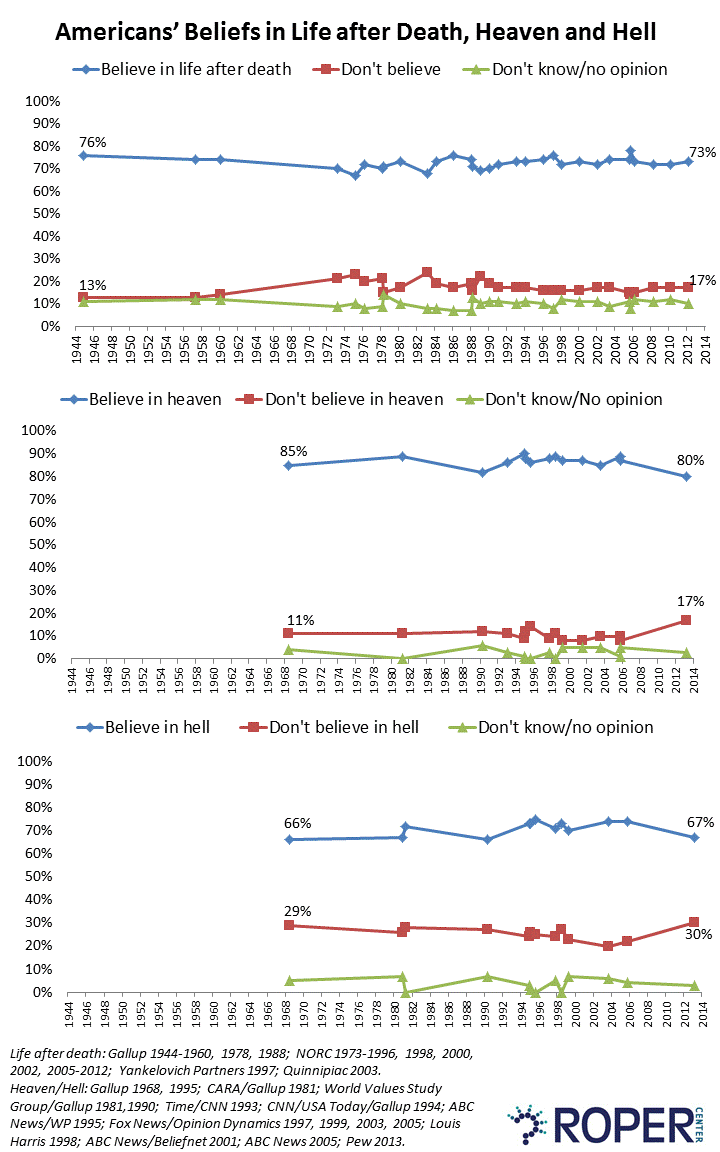
A large majority of Americans believe in life after death, though the specifics of their beliefs varies considerably.   Somewhere between about 70% and 90% of Americans believe in some kind of life after death.  Only a small minority of Americans do not believe in an afterlife.  There is wide divergence of belief in the details of life after death, with a number of inconsistencies in the range of beliefs about immortality. 

Most Americans (about 80%) believe in Heaven.   Curiously, according to one survey, a higher percentage believe in Heaven than those who believe in life after death.  A smaller number (about 60%) believe in both Heaven and Hell.  A minority group believes that a person exists after death and lives on in a spiritual form in another dimension, but not heaven or hell.  About 50% of Americans believe in ghosts here on earth.  About 20% believe in reincarnation.  There is considerable overlap among individuals’ various beliefs about the afterlife, whether about heaven, hell, a separate spiritual existence, ghosts, reincarnation, or some combination of these.

Dante: Inferno, Purgatory, and Heaven
The Divine Comedy, an epic poem written by Dante Alighieri (1265 – 1321), set much of the popular imagery about heaven and hell.  The poem tells of an allegorical journey through hell, purgatory and heaven, as guided by the Roman poet Virgil, and Dante’s life-love, Beatrice.  Each realm of the afterlife is divided into ten circles, representing gradations of sin, circumstance, and merit.  The construct is an attempt to render the afterlife comprehensible from the standpoint of justice.  The simple duality of damnation and paradise is too stark and simple as judgment for the complexity of human experience.  Thus, the souls of pre-Christian philosophers and babies who died before baptism were sent to limbo, in purgatory, according to tradition. 
Illustration of Hell from the 11th century manuscript Hortus Deliciarum (Garden of Delights).

The Christian View of Heaven and Hell
The remainder of this post will focus on the mainstream American Christian belief in Heaven and Hell as destinations in the afterlife.

Jesus will come again with glory to judge the living and the dead.
                                                                -- Nicene Creed
He ascended into heaven, and sits at the right hand of God the Father Almighty:
From thence he shall come to judge the quick and the dead.
                                                                -- Apostles’ Creed

It is interesting to note that in the language of the creeds, judgment does not occur at the moment of death, but happens later, at the second coming of Christ.  This is contrary to a common belief about the immediate disposition of the soul at the time of death. 

The ideas of Heaven and Hell are cornerstones of traditional Christian belief.  These beliefs are directly rooted in the teachings of Christ.   In the Parable of the Sheep and Goats, Jesus says that people who ignore the needs of the poor are cursed, and will be thrown “into the eternal fire prepared for the devil and his angels”.  Jesus also spoke directly of heaven, saying to one of the thieves crucified with him, “Today you will be with me in Paradise”.

The fundamental question here is whether the concepts of heaven and hell pass the test of reason.  Why do we briefly live on earth, if we are to exist for eternity after we die?   And if existence has such an asymmetrical duration, why did God create the realms of life and death? 


Heaven
The Heaven of the Old Testament is quite different than the Heaven of the New Testament.  The Old Testament (Genesis, Daniel, Nehemiah, Kings, Ezekiel, Exodus, Psalms) describes Heaven as the skies above, and the place where God and angels dwell.  Except for Elijah, who was specifically chosen to rise to heaven, it is not described as a place where humans go after death. 

Heaven in the New Testament is quite different.  Jesus speaks often of heaven, of God the Father in Heaven, and of the Kingdom of God in Heaven.  Jesus tells his disciples that they can aspire to Heaven, although he cautions that rising to heaven is not easy.  Jesus says that unless his followers are more righteous than the Pharisees and teachers of the law, they will not enter Heaven (Matthew 5:20), and says that it is easier for a camel to pass through the eye of a needle than for a rich man to enter the Kingdom of God (Matthew 19:24).   

Gustave Dore, Paradise, 1892

But what is heaven, when we get past the cartoons of popular culture -- the pearly gates of Saint Peter and the white-winged angels standing on puffy clouds and holding harps.  What would eternal life be like?  What would it be like after one hundred years?  After the first million years?   After the first billion years?  After the hundredth billion years?  Would any aspect of the human personality persist over such lengths of time?  What is the meaning of eternal life, as promised by Jesus Christ? 

We’ve previously considered the qualities of the human soul, as expressions of the human self: memory, will, self-awareness, thoughts and emotions.  How could these persist for a billion years?  What would remain after these things fade?  Why did God create the realms of life and death, if life in Heaven resembles life on earth?  What does the survival of the soul mean if life in Heaven is different for eternity?  We might consider that the human soul could transform into something else, into a higher kind of being, but for what purpose?  Certainly, whatever might remain after a billion years would no longer be human.  What would such a being do?  What would it think?  Why would it exist, and why would it have begun its existence as a mortal human life? 

Hell
Our idea of Hell as a place of fire and torment is drawn directly from the Bible and the words of Jesus.  It is also clear from the words of Jesus that heaven is reserved for only the exceptional few, the most worthy in the sight of God.   What, then, happens to the rest?  By default, they are consigned to hell, or the middling realm of purgatory, as described by Dante in 1320.

Purgatory, Gustave Dore
Theologians and others have spent considerable mental energy in trying to rationalize the justice implicit in consignment to Hell.  Dante’s Inferno is typical of these rationalizations, where different levels of Hell are allocated according to differing levels of sin.  (I have not read Dante, to my regret.)  For example, pre-Christian philosophers such as Socrates was assigned to the relative comfort of the first circle of Hell, because they lived their lives with honor, virtue and integrity, but were not given the opportunity for baptism or salvation.  Dante’s vision of Hell continues in incremental fashion through moderate levels of torment to the deepest levels, reserved for the greatest sins.   Botticelli’s painting of Hell follows this pattern, with the caverns of hell connected vertically by staircases.  Tormented souls lie prostrate along the halls, and the dungeons become smaller with depth.  [The model implies a skewed statistical distribution of wickedness, with relatively mild sinners greatly outnumbering deeply evil human souls.  The model is intuitively correct.]
The Map of Hell, Botticelli, circa 1480 -1490.

But there is limited fairness in this.  Why did God design a world where honorable men had no opportunity for salvation, simply because Christ arrived too late?  

Calvinists take this idea to a horrifying level based on the presumed omniscience of God.  In the Calvinist view, each soul is predestined at conception for either salvation or damnation.  Indeed, since all is known, each soul is predestined for heaven or hell at the beginning of creation.   What kind of justice is this?   What kind of God would call souls into existence, knowing they are doomed for eternal torment and suffering?  What does this say about free will of humans, individual morality and judgment?  What does this say about the goodness of God?  I am reminded of a scene from Disney’s “Fantasia”, during the piece by Mussorgsky, “Night on Bald Mountain”.  The Ukrainian demon Chernobog (literally “Black God”, representing Satan) conjures a handful of flames into beautiful flaming dancing women.   He then torments them through several transformations, each uglier than the last.  Finally, bored with his game, he crushes them out of existence in his fist.   What is the difference between this and the Calvinist view of God, except that the Chernobog eventually ends the torment of his victims, and the Calvinist God torments his created souls for all of eternity?

Summary
What kind of God would construct hell?  Do the ideas of Heaven and Hell pass the tests of reason and justice?

An Eskimo hunter asked the local missionary priest, 'If I did not know about God and sin, would I go to hell?'
'No,' said the priest, 'not if you did not know.'
'Then why,' asked the Eskimo earnestly, 'did you tell me?'

We tend to rationalize our visions of divine judgment by constructing models which meet our standards of reason and justice.  Thus, we have Dante’s concentric circles of Hell, with degrees of punishment aligned to degrees of sin.  We have the vision of Saint Peter at the Pearly Gates, checking his list like a bouncer at an exclusive nightclub.  But what basis do we have for imagining reward or punishment?   We have scripture, scripture contains none of the detail which is needed to answer questions of justice.  Further, Judeo-Christian scripture is only one of 3000 competing visions of what divine justice means.   We also have our human instinct for fairness, which we share with many higher creatures.   But to construct models of judgment which meet our standards of reason and justice, and then justify those models based on our instinct for sense and fairness is circular reasoning. 

The idea of Hell fails the standard of justice, because the punishment of eternal torment is disproportionate to any conceivable sin.  The idea of hell is also incompatible with the idea of a good and loving God.  Christians who embrace the idea of a loving God must logically reject the idea of eternal damnation, torment and suffering.  Eternal torment is an asymmetric and unjustified punishment for any temporal sin.  And yet we have no basis for ameliorating the model, simply to satisfy our desire for fairness.  The idea either meets the standard of justice, or not.  And it doesn’t.  Either God is not a loving God, or there is no hell.
William Blake, The Book of Urizen

The idea of Heaven fails the standard of reason.  The immortal existence of the soul, extending into infinite time as a coda to our brief lives, also has an illogical asymmetry.  Why is life in the material world so brief, if the soul lives in Heaven so long?   I have a lot of things to do.  There are a lot of things I should do, but I lack the lifetimes to do what needs to be done.  And I could pass eternity in Heaven with a harp, but that will not allow me to take care of real problems here on earth.  A loving and omniscient God working with intelligent design would have given me a little more time on earth and a little less time in Heaven.

Judging God, rather than being judged, is a revolutionary idea.  I freely admit I stole the idea from physicist David Deutsch, in the book “The Beginning of Infinity”, which I highly recommend.  As reasoning beings, we are obligated to judge God (and our beliefs) according to the standards of reason, justice and goodness.   Belief in Heaven fails the standard of reason.  Belief in Hell fails the standards of reason, justice, and the goodness of God.  A reasoning person must reject these beliefs. 
--
Illustrations:


References:
Elizabeth Cotten (1893-1987), grandchild of American slaves, was self-taught on guitar and became a recognized folk artist in her 60s.  Cotton composed “Freight Train” at the age of 11, performed it in public for the first time at the age of 67, and won a Grammy award for the song at the age of 93.
Like many folk songs from 1850 - 1900, the song is an allegory of death, represented as a train.  


Thursday, September 15, 2016

Does the Creation of the Universe Imply the Existence of God?

“Is there a God?  I don't know. 
Is there an angry unicorn on the dark side of the moon?  I don't know.”
Edward Abbey

God, the Creator
This post will consider the question of God himself.   As discussed in the first post of this series, the question of belief in God first requires a definition of God.

The traditional Christian view is that God is omnipotent; omniscient, infinitely good, and above all, interested in Mankind.  Traditionally, God is believed to be Creator of all things, Sustainer of all things, Redeemer of Souls and Judge of all people.   This post will consider God as Creator of the Universe. 

This image by the infra-red JWST shows the earliest known galaxies in the Universe, 
younger than galaxies imaged by the Hubble telescope.

God as Creator
Of all the arguments for the existence of God, the idea of God the Creator seems the most compelling.  The universe exists.  Science is clear that the universe began in a discrete moment of Creation about 13.8 billion years ago.  At that moment, in a flash of pure energy, all of the matter, energy, forces and dimensions of the universe, including space and time, expanded from a single infinitesimal point.  Scientific theory and astronomical observation agree that the Big Bang event occurred; that discovery and proof is one of the greatest achievements in the history of human thought.  And for all of the complexity of the scientific story, it is amazingly similar to the much simpler account in Genesis: “God said, ‘Let there be light.  And there was light.’” 

If Creation occurred as a distinct event, doesn’t that imply a Creator?  Perhaps it does.

To me, the fact of Creation is the most reasonable of all arguments that God exists.  But what kind of God is implied by this moment of Creation, and what is humanity with regard to God, the Creator of the Universe?

Further Evidence of a Creator:  The Fine-Tuning Problem

Recent thinking in physics and cosmology gives further credence to the idea of a Creator.  There are physical constants which govern the forces in the universe and which bind matter together.  These constants form a set of parameters which allow matter to exist, allow atoms and star systems to form, and allow you and me to exist to contemplate these questions.  It turns that the values of these constants are necessarily very specific.  If any of these constants varied from their known values by even a tiny amount, then the universe would not be filled with molecules and galaxies, but might be filled with ionized plasma or pure energy, or perhaps some other dimensionality of space.  Physicist David Deutsch calls this the “fine-tuning problem”. 

One branch of modern physics deals with the fine-tuning problem by invoking the idea of the multi-verse – an infinity of universes encompassing all possible values of the fundamental physical constants.  Our universe, in this view, is not special.  We are simply one of the universes in which matter, life and bloggers can develop.  We are writing about it because life in this universe is possible.  In this view, our existence simply represents survivorship bias, not a specially constructed universe.  We are writing about the fine-tuned universe because life is only possible in the fine-tuned universe.  The problem with this interpretation is that there is no evidence of other universes.  In the absence of evidence, whether we believe that the universe was purposefully designed for life by a Creator, or is simply a random occurrence is still a question of personal preference.

Does the Existence of a Creator Validate the Traditional Concept of God?
Some philosophers argue that the evidence of a Creator proves the existence of Judeo-Christian God, omniscient, omnipotent and good.  A good example of that thinking can be found in Jim Holt’s interview with Oxford professor Richard Swinburne, in Holt’s book Why Does the World Exist?, chapter six.  But does that necessarily follow?

Does the act of Creation necessarily mean that the Creator is also omniscient, able to foresee all details of Creation through time?  I don’t think so.  The Creator may have started something with no idea how it would turn out. 
Does the act of Creation give the Creator omnipotent powers to intervene in what has been created?  Again, I don’t think so.  In our own earthly endeavors, we sometimes start something which is beyond our ability to influence or control.

And does the act of Creation demonstrate that God is good?  The Gnostic religions provide an interesting interpretation of Creation, which casts doubt on whether the Creator is necessarily good.

Gnosticism is a set of religions which developed in the second century, drawing on a variety of earlier sources, including early Christianity.  Gnostic belief holds that there are two levels of reality, a lower, corrupt physical reality, and a higher, perfect spiritual reality.  This aspect of Gnosticism may derive from the teachings of Plato, who lived six hundred years earlier.  According to Gnostic belief, the physical world was created by the demiurge, a lesser spiritual being than God.  Because the physical world is intrinsically corrupt, the being that created it is also believed to be corrupt.  The demiurge is sometimes considered to be Satan. 

So, upon reflection, the Big Bang and the existence of the universe may suggest the action of a Creator, but there is no evidence that this Creator is the God of Judeo-Christian belief.  The Creator may be good, evil, or indifferent; perhaps even unaware of the existence of mankind’s brief existence on a small planet in an unremarkable galaxy. 

Mankind’s Place in the Universe

For a moment, let’s accept that the Big Bang and the structure of our universe imply the existence of a Creator, and that our universe is deliberately fine-tuned for life, by design.  Let’s consider our place in this universe. 
Hubble Deep Field Image, showing galaxies of the early universe.
The image covers an area of sky equal to about 1/100 of the size of the full moon.

According to current estimates, there are about 100 billion galaxies in the universe.  Perhaps coincidentally, there are about 100 billion stars in the average galaxy.  The number of planets orbiting stars is still unknown, but the recent discovery of over 4000 planets outside the solar system suggests that planets are relatively common.  For a simple calculation, let’s assume that there is an average of 1 planet per star.  This means that earth is one of about 1,000,000,000,000,000,000 planets in the universe.

Let’s also consider how long humans have lived on earth, and have had a relationship with God.  Anatomically modern humans first appeared about 200,000 years ago.  Since the earth is 4.6 billion years old, people appeared only in the last 0.000004th fraction of the life of the earth.  If we take Earth as an average planet, then humans have occupied 1/23,000,000,000,000,000,000,000 of the available planet time in the universe. 

As I consider the scale of space and time, in comparison to the scale of humanity, I think it is fair to say that whatever the purpose of the universe is, it isn’t about us. 

The Relationship between Mankind and God, and Revelation of God to Mankind.

The current year of the Jewish calendar is 5775, counted from the believed creation of the world.  The Jewish religion is one of the earliest monotheistic religions, and archeology places the origin of Judaism at about 3500 years ago.  One might ask why God waited until 3500 years ago to reveal himself to mankind.  Perhaps we only know of God’s revelation to humans after the development of writing. 

According to some sources, there are an estimated 4200 distinct religions.  Many of those are now extinct, and an unknown number have been lost without record.  There are artifacts and evidence of ritual dating to as early as 35,000 years ago.  Ancient Egyptian religious traditions were already established 5000 years ago, and persisted for about 3000 years.  Many early religions were polytheistic, animistic or related to ancestors.  There is a bewildering variety of traditions about spirits and gods, and customs of worship.  Modern Western philosophy has tended toward monotheism, exemplified by the Judeo-Christian and Islamic traditions, but developed independently by Greek philosophers and by other middle-eastern religions. 

The question is, why is the revelation of God to humans so muddled?  Was the one true revelation of God given to Akhenaten or Zoroaster?  To Abraham or Pythagoras?  To Siddhartha Gautama, Confucius, Zeno, Jesus, Mohammed, Joseph Smith or L. Ron Hubbard?  Or to any of thousands of other prophets?  If divine guidance is present, shouldn’t we expect a little more consistency?

Certainly, there is sometimes deep wisdom in the teachings of these prophets.  But it seems to me that it is a particularly human kind of wisdom, filled with contradictions and errors, rather than a perfect, divine revelation. 

The Nature of Reality I – The Multiverse
When we consider the question of whether God is the Creator of the Universe, we tend to focus on the question of God.  But we should also consider the question of what God has created.  What is reality?
Modern physics continues to produce ever-stranger evidence for the nature of reality.  Physicist David Deutsch writes convincingly of the evidence for the multiverse, an infinite series of alternate universes composed of all possible events, down to the level of sub-atomic particles.  Deutsch is the world’s leading expert in quantum computing, and is using these ideas in a practical sense to build computers that work.  By analogy, it may not be absolutely necessary to accurately understand electricity in order to have a glowing light bulb, but it certainly helps.  Deutsch’s working quantum computers give credence to his notions about the multiverse.

If Deutsch is correct about the multiverse, everything that can happen has happened, or will happen.  In such a multiverse, how can good or evil exist?  How does the moral choice of mercy or cruelty exist?  Anything good in one version of reality is matched by something bad in an alternate reality.  What is the role of God in this vision?  As creator, he created all possibilities, and all realities.  But in this view, there is no good and no evil, just endless variation across all possibilities.  And the first criterion of our conception of God – that he is good – is void.

The Nature of Reality II – Is Reality Material or Non-material?
A different problem exists with the possibility that reality is non-material.  Perhaps it should make no difference whether matter and energy and human beings are physically real, or some digital representation.  We might consider God the Great Programmer. 

If we are merely a digital representation, it is more plausible that Creation is all about us.  Perhaps a forest is only a statistical model, until a person walks into it.  Perhaps leaves on a tree are only a blur, until we put on our glasses to see individual leaves.  Perhaps the stars were only diffuse light, until the invention of telescopes, and distant galaxies only shapes that approximate the gravitational aggregation of matter into stars.  If so, our very history may be suspect.  We may have been created yesterday with our memories pre-formed.  People who deny evolution sometimes approach this idea, when they say that God planted fossils in the ground as a test of our faith when He created the world 6000 years ago. 

But I have to ask why God would be so deceptive.  If we take the idea that we are special further, perhaps humanity lives on the only inhabitable planet – all the rest may be illusion.  It is solipsism for a species.  Perhaps other races, other people are also illusion.  Perhaps God is only concerned with you, the reader, and I am an illusion typing this blog post.  And the Great Programmer created the illusion of a philosopher to invent the word solipsism for this situation. 

Conclusion
I believe that the idea of solipsism is absurd.  I believe in the physical reality of the universe, the reality of the people around me and in the truthfulness of my senses and scientific instruments.  I do not choose to believe that God would be deceptive towards mankind, in creating illusions of any kind. 

Belief in the physical reality of the universe, in the scale that we observe, leads me to believe that mankind is a small part of the universe.  Mankind has existed for an infintesimally trifling part of the space and time in the universe; I don't think it is all about us.  Mankind is not the greater purpose of Creation, whatever that may be.  The existence of Creation may imply a Creator, but the Creator does not necessarily conform to the Judeo-Christian concept of God -- infinitely good, omniscient and omnipotent.  The Creator may be good, evil or indifferent to mankind; capable of intervention in the world or not.  The Big Bang is perhaps evidence of a Creator, but that Creator does not imply the existence of the Judeo-Christian God.

----
References:
Jim Holt, 2012, Why Does the World Exist, 320 p.
David Deutsch, 2012, The Beginning of Infinity, 496 p.
Alan Lightman, 2013, The Accidental Universe, 176 p.
Richard Preston, 1996, First Light, 275 p.