Showing posts with label Heaven. Show all posts

Friday, November 10, 2023

Extraordinary Claims Require Extraordinary Evidence

Carl Sagan popularized the phrase “Extraordinary claims require extraordinary evidence” (ECREE), in his 1979 book “Broca’s Brain” and the Cosmos television mini-series in 1980.  Sagan was drawing on previous use of the concept by Marcello Truzzi in the 1970s, Thomas Jefferson and Pierre-Simon LaPlace in the early 1800s, and ultimately by philosopher David Hume in his 1748 essay “On Miracles”. 
 
“Extraordinary Claims Require Extraordinary Evidence”
Carl Sagan, 1979
To make sense of the aphorism, we should first ask what qualifies as an extraordinary claim.  There are three classes of extraordinary claims:
  • Statistically improbable claims.
  • Claims outside the range of prior experience, with unknown probability.
  • Claims contrary to the body of established scientific knowledge or preponderance of existing evidence.
Religious ideas are of the third kind, assertions that are contrary to established scientific knowledge.  (I will discuss other kinds of extraordinary claims and evidence in my science blog.)  Religious or spiritual claims are closer to Hume’s original idea about extraordinary claims in 1748 than the other kinds of extraordinary claims.  

                        “What is a miracle?”
                        “A miracle is something that happens contrawise to the will of nature.”
                                            Source is forgotten, likely to be Robert Heinlein or A.C. Clarke


Social scientist Marcello Truzzi, who founded an organization to investigate paranormal claims, coined a similar wording of the ECREE aphorism that Sagan later used.  In 1978, Truzzi wrote, “extraordinariness must be measured against theoretical expectations provided by the general body of scientific knowledge at the time...claims require extraordinary evidence if they entail the falsehood of established scientific results that are themselves extensively tested and well understood.... A black swan is one thing; a swan that visits you from beyond the grave is something else.”

Religious Claims
Let’s try to summarize religious and spiritual claims.  It won’t be easy.  There are about 3000 distinct religions followed by some group of people, now or in the past.  From this variety, it may be difficult to compile a simple list of religious claims, but I will try, using parallel ideas in a number of religions.  

God and Gods
, each having many of the following characteristics:
    Non-corporeal, invisible, silent spirits.
    Immortal.
    Capable of magic or miracles.
    Interested in humanity.
    Intervening in human affairs.
    Responsible for creation of the world, or parts thereof.
    Often engaged in conflict with other gods, spirits, or beings.
    Protecting humans from evil spirits, people or natural disasters, often in exchange for worship.
    All-powerful.
    All-knowing.
    All-good. (In some traditions, not all.)
    
Divine Creation of the World
    Creation of the universe or world by gods or other spiritual beings.
    Creation of the living world.
    Distinct creation of people, separately and above the living world, and endowment of people with sentience, knowledge or wisdom.
    Creation of the spiritual realm, of heaven and hell.

Sacred Gifts
    Gifts of knowledge or other gifts to humanity, including positive and negative gifts.

Immortal Souls
    Spiritual, immortal extension of the human self, capable of existing without the body after death.
    Includes self-awareness, memory, will, thoughts and emotions.
    Generally believed to travel to non-material spiritual places after death -- Heaven, Hell, Limbo, Valhalla, Folkvangr, the seven Samaawat, Alma d-Nhura, Deva Loka, Narka Loka, etc.

Human Spirits
    Ghosts existing after life in the physical world (but not necessarily immortal).  May include malevolent spirits.

Divine Superior Beings
    Demi-gods, including Jesus, Maui, and Heracles, and divine relatives, including the Virgin Mary.  Often considered the offspring of god or gods, sometimes through parthenogenesis, sometimes the offspring of humans and gods.  Often believed to have a previous physical life, but currently are non-corporeal spirits.  Prayer for intercession is often directed toward divine superior beings rather than to God.

Spiritual Superior Beings

    Angels, demons, animal or natural spirits with greater magical power than humans or human spirits.
    May include antagonistic spirits such as Satan.

Afterlife Places

    Heaven, limbo and hell.  Places without a physical presence or contact with the physical world, where one can meet people from one's former life.

Miracles
    Extraordinary events, contrary to expected behavior of natural systems, generally for the benefit of people experiencing difficulty.

Divine Causation

    Routine natural events, seasons, tides, eclipses.
    Routine human events, birth, death.
    Movement of heavenly bodies.
    Extraordinary events as reward or punishment (usually punishment), including natural disasters, virgin birth, ascension to heaven.

Natural Spirits
    Attribution of living identity, will or sentience to animals, plants, places and objects; anthropomorphism of nature.  

Sacred Places
    Attribution of sacred living identity to mountains, rivers, and lands.  Sacred objects and places are believed to enable religious miracles.     

Spiritual Inanimate Objects and Places

    Religious icons, relics of saints, churches, temples, springs and objects or places believed to have magical powers or enable miracles.

Reincarnation
    The belief that souls are recycled into new people or animals.  Some religions attribute a “leveling-up” process of attaining higher or lower status according to moral behavior during life.

Divination and Prophecy
    Belief that the future can be determined by religious ritual or by religiously endowed individuals. 

Saints and Spiritual Intermediaries

    Belief that the spirits of sacred humans can intervene and influence God’s actions, or parallel beliefs in non-Christian religions.

Sacred Texts
    Belief that the Bible, Devi Bhagavatam, Quran, Book of Mormon or other sacred texts are divinely inspired, contain divine revelation, are literally true, and have an absolute obligation to be obeyed.
    
Prayer
    The belief that humans can communicate with gods and higher beings, to give thanks and ask for divine help.

Ancestor Worship
    Belief that deceased ancestors actively intervene and protect their descendants.

Human Religious Intermediaries Priests, Pastors, Popes, and Shamen
    Belief that special humans possess magical powers or can intervene to influence divine action.

Divine Humans

    Egyptian, Roman and Japanese societies held that their leaders were gods, or became gods when assuming office as emperor or pharaoh.  Chinese and other cultures believed that their leaders were semi-divine descendants of gods.

Belief in Transcendent Reality, and/or denial of physical reality.

    Belief that physical reality is corrupt and is superseded by a transcendent reality.

Karma
    Belief that good or bad actions have real-world consequences in luck or future events.

Ordinary Scientific Evidence
The scientific method systemized the search for truth and standardized the criteria for truth, beginning in the 17th century.  Scientific evidence involves the following elements.
  • Empirical observation.
  • Identification of processes and developing hypotheses about processes.
  • Experiments designed to fulfill predictions or invalidate the hypotheses.
  • Clarity of data from experiment.
  • Repeatability.
  • Relevance of evidence, often measured by statistical tests.
  • Peer review and publication.
In general, religious claims fail most or all of the standards for scientific truth (or as it is otherwise known, truth).  Stories of 14th century BCE conversations with a burning bush or visions by a 15th-century French girl do not qualify as evidence.
 
Moses and the Burning Bush, Holman Bible, 1890

Vision of Joan of Arc (1428), artist and date unknown to me.

With religious claims, there are few repeatable observations with objective observers.  There are no identified processes.  There are no experiments to invalidate the claims.  There is little clarity of the data.  There is often little relevance of the evidence, and little critique of the claims.  We see that religious claims fail to meet standards for ordinary evidence before even considering the need for extraordinary evidence,

Why Are Religious Claims Extraordinary Claims?
Religious claims are extraordinary claims because they violate known scientific knowledge about processes.  The list of religious claims is too long for a complete rebuttal, but fall into four general categories.  First are claims involving spirits, second are claims involving higher classes of beings, third are claims involving miracles and fourth are claims of future knowledge or predestination.

Spirits represent disembodied beings, with self-awareness, memory, will, ability to communicate and other powers.  But scientific knowledge places the seat of sentience in the brain.  Through observation of patients with brain injuries (as described well in the books by Oliver Sachs) we know which parts of the brain enable these aspects of sentience.  We can observe patients in which memory, will and communication are gone, and have established that the brain performs those functions of humanity.  Without a physical brain, spirits cannot have sentience; souls cannot persist after death.  To claim otherwise is an extraordinary claim, and requires extraordinary evidence.  

The same reasoning applies to the existence of higher beings, gods, demi-gods, angels and demons that are believed to exist in the spiritual world.  Without a brain, how do they think?  How do they persist as self-aware entities?  To claim that an angel or demon possesses sentience without a brain violates our scientific understanding of sentience.

Religious claims of miracles and magic are also extraordinary claims.  We know how physics, chemistry, and life sciences work.  A miraculous event, by definition, is contrary to the expectations from those natural processes.  As such, every miracle or magical claim requires extraordinary evidence.

Claims of prophecy and predestination violate the scientific understanding of time.  In all well-documented experience, information can not flow backwards through time.  Future events are fundamentally uncertain, despite high precision in prior conditions and known processes.

Extraordinary Evidence
What is extraordinary evidence, as compared to the normal scientific evidence described above?  

I return to David Hume, who first established the ECREE standard in 1748.  “No testimony is sufficient to establish a miracle, unless the testimony be of such a kind, that its falsehood would be more miraculous than the fact which it endeavours to establish”.  

In essence evidence of a miraculous event must be strong enough to invalidate the scientific knowledge precluding that event.  To be considered true, a miracle involving levitation must be supported by evidence sufficient to invalidate our well-established notions about gravity.  To be considered true, the claim of a soul, ghost or spirit must demonstrate disembodied sentience in some unquestionable, observable, repeatable form.  The claim that God exists needs to be demonstrated by apparently unlimited power – perhaps by moving thousands of galaxies overnight to spell out, “I am God” in every language on earth.  Of course, none of those things have ever happened or ever will happen.

Conclusion
Religious claims are extraordinary claims, defying our existing body of scientific knowledge.  Religious claims fail to meet even the lowest standards of scientific evidence, much less the extraordinary evidence required for such claims to be regarded as truth.  
----
Afterword
Non-Religious Paranormal Beliefs
There are also a substantial number of non-religious paranormal beliefs, some of which overlap with religious beliefs.  Some (telekinesis, telepathy, extraterrestrial visitors) do not involve spiritual elements, while others (ghosts) do not involve higher spiritual powers.  These also require extraordinary evidence, but are irrelevant to the discussion of atheism.

Non-Interventionist God
Albert Einstein said, "I'm not an atheist, and I don't think I can call myself a pantheist... I believe in Spinoza's God who reveals himself in the orderly harmony of what exists, not in a God who concerns himself with fates and actions of human beings”  The Jewish philosopher Baruch Spinoza (1632-1677) framed a special case of the non-interventionist God.  Spinoza held to a physical sense of reality, but viewed all of creation as a sub-set of God.  According to commentator Paul So, Spinoza “rejected the existence of Soul, Angels, Demons, Miracles, Divine Creationism, the possibility of Afterlife, Divine Revelation, validity of Prophecy, Biblical literalism, Tradition, Scriptural authority, and last but not least the existence of a personal God.”

Giordano Bruno in the 16th century rejected many of these same religious claims, while introducing revolutionary speculative cosmological ideas that are today held as true.  He speculated that stars were far-away suns, that planets might orbit those suns, and that intelligent beings might live there.  He also made contributions to the study of memory, mathematics, geometry and language.  Bruno may have been approaching the rationalist’s idea of a non-interventionist God, but was burned at the stake for heresy in 1600.
Giardano Bruno, 1548-1600, portrait from 1830 biography.
Execution of Giardano Bruno, source unknown to me.

Spinoza’s non-interventionist God eliminates most, but not all, of the unsupported religious claims.  Spinoza’s God presumes that God is the creator; that God is reality, and that God is greater than reality.  These claims are also unsupported by evidence. 

Baruch Spinoza, 1632 - 1677.
Spinoza tried to rationalize religion by removing the most fantastic claims, and altering the definition of God to equate God with our observed reality.  But God is unnecessary to explain our observations, and equating God with reality brings no additional understanding.  There’s also no evidence, extraordinary or otherwise, that God is greater than our reality.  The central claim that God exists is completely unsupported.  According to Occam’s razor, the best explanation of our reality is that God does not exist.

Sunday, February 19, 2017

God as Judge: Heaven and Hell -- The Afterlife, Part II

The Afterlife, Part II, Heaven and Hell
Do the concepts of Heaven and Hell pass the test of reason and justice?

Imagine there's no heaven
It's easy if you try
No hell below us
Above us only sky
Imagine all the people
Living for today
“Imagine” – John Lennon

Please don’t tell what train I’m on, so they won’t know which route I’ve gone.
                                “Freight Train” – Elizabeth Cotten, modified by various folk singers.

Death
Death is perhaps the most unsettling aspect of our existence as sentient beings.  We exist.  As Descartes said, “I think, therefore I am.”  We know our existence had a beginning at conception or at birth, although we do not remember it.  And we know that our existence (as we know it) will cease at death, although it may be impossible to actually contemplate our own non-existence. 

The question of what happens at death has been with us for a long time.  Socrates had something to say about it after receiving his death sentence for impiety and corruption of the youth.  Socrates always had something to say.  That was part of his problem.
“….we shall see that there is great reason to hope that death is good, for one of two things: - either death is a state of nothingness and utter unconsciousness, or, as men say, there is a change and migration of the soul from this world to another.”

“if you suppose that there is no consciousness, but a sleep like the sleep of him who is undisturbed even by the sight of dreams, death will be an wondrous gain…for eternity is then only a single night.”

“….if death is the journey to another place, and there, as men say, all the dead are, what good, O my friends and judges, can be greater than this? If indeed when the pilgrim arrives in the world below, and he has escaped from those who call themselves jurymen in this world, and finds the true jurymen who are said to give judgment there, Minos and Rhadamanthus and Aeacus and Triptolemus, and other sons of God who were righteous in their own life, that pilgrimage will be worth making. What would not a man give if he might converse with Orpheus and Musaeus and Hesiod and Homer? Nay, if this be true, let me die again and again.”

                                                                                Socrates, 399 B.C. in Plato’s “Apology”
“Apology” is the account of Socrates self-defense in his trial for impiety and corruption of the young, in which he was sentenced to death.

American Views about the Afterlife
Socrates framed the question of what happens at death as a duality; either nothingness, or judgment in another place.  In Socrates’ view, judgment was not given by God, but by men who had been righteous in life.  The question of punishment for the sins of this life is not considered. 

In the 2417 years since Socrates, we are no closer to a consensus about what happens at death.

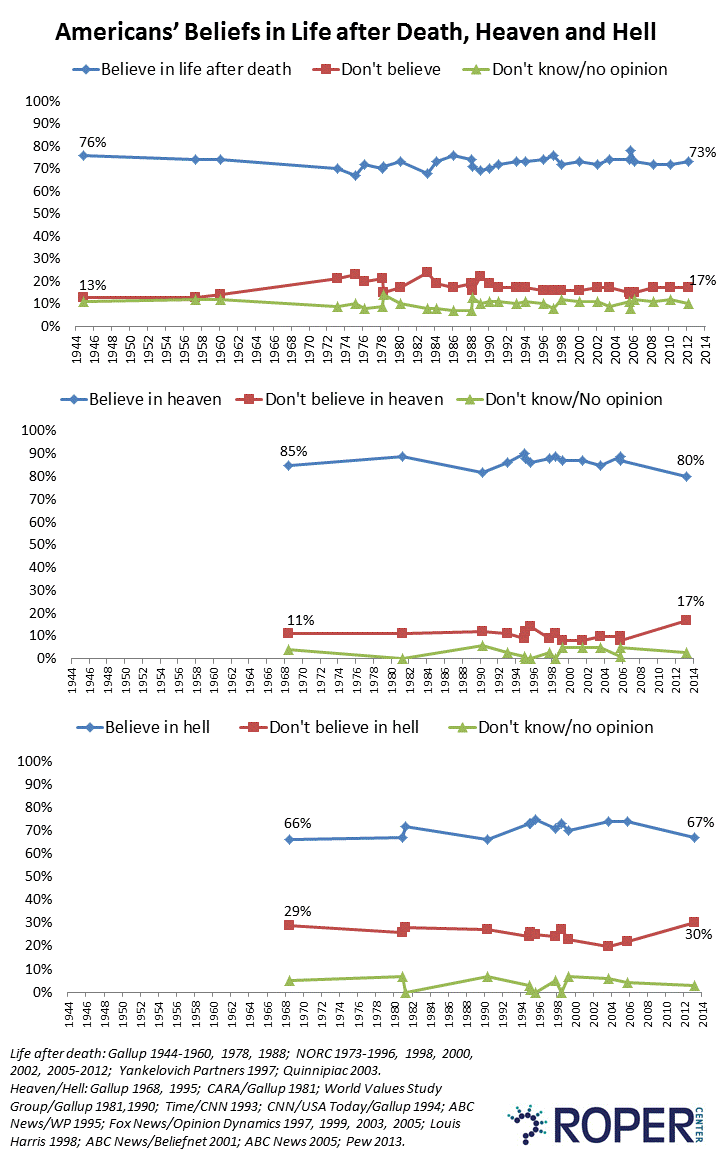
A large majority of Americans believe in life after death, though the specifics of their beliefs varies considerably.   Somewhere between about 70% and 90% of Americans believe in some kind of life after death.  Only a small minority of Americans do not believe in an afterlife.  There is wide divergence of belief in the details of life after death, with a number of inconsistencies in the range of beliefs about immortality. 

Most Americans (about 80%) believe in Heaven.   Curiously, according to one survey, a higher percentage believe in Heaven than those who believe in life after death.  A smaller number (about 60%) believe in both Heaven and Hell.  A minority group believes that a person exists after death and lives on in a spiritual form in another dimension, but not heaven or hell.  About 50% of Americans believe in ghosts here on earth.  About 20% believe in reincarnation.  There is considerable overlap among individuals’ various beliefs about the afterlife, whether about heaven, hell, a separate spiritual existence, ghosts, reincarnation, or some combination of these.

Dante: Inferno, Purgatory, and Heaven
The Divine Comedy, an epic poem written by Dante Alighieri (1265 – 1321), set much of the popular imagery about heaven and hell.  The poem tells of an allegorical journey through hell, purgatory and heaven, as guided by the Roman poet Virgil, and Dante’s life-love, Beatrice.  Each realm of the afterlife is divided into ten circles, representing gradations of sin, circumstance, and merit.  The construct is an attempt to render the afterlife comprehensible from the standpoint of justice.  The simple duality of damnation and paradise is too stark and simple as judgment for the complexity of human experience.  Thus, the souls of pre-Christian philosophers and babies who died before baptism were sent to limbo, in purgatory, according to tradition. 
Illustration of Hell from the 11th century manuscript Hortus Deliciarum (Garden of Delights).

The Christian View of Heaven and Hell
The remainder of this post will focus on the mainstream American Christian belief in Heaven and Hell as destinations in the afterlife.

Jesus will come again with glory to judge the living and the dead.
                                                                -- Nicene Creed
He ascended into heaven, and sits at the right hand of God the Father Almighty:
From thence he shall come to judge the quick and the dead.
                                                                -- Apostles’ Creed

It is interesting to note that in the language of the creeds, judgment does not occur at the moment of death, but happens later, at the second coming of Christ.  This is contrary to a common belief about the immediate disposition of the soul at the time of death. 

The ideas of Heaven and Hell are cornerstones of traditional Christian belief.  These beliefs are directly rooted in the teachings of Christ.   In the Parable of the Sheep and Goats, Jesus says that people who ignore the needs of the poor are cursed, and will be thrown “into the eternal fire prepared for the devil and his angels”.  Jesus also spoke directly of heaven, saying to one of the thieves crucified with him, “Today you will be with me in Paradise”.

The fundamental question here is whether the concepts of heaven and hell pass the test of reason.  Why do we briefly live on earth, if we are to exist for eternity after we die?   And if existence has such an asymmetrical duration, why did God create the realms of life and death? 


Heaven
The Heaven of the Old Testament is quite different than the Heaven of the New Testament.  The Old Testament (Genesis, Daniel, Nehemiah, Kings, Ezekiel, Exodus, Psalms) describes Heaven as the skies above, and the place where God and angels dwell.  Except for Elijah, who was specifically chosen to rise to heaven, it is not described as a place where humans go after death. 

Heaven in the New Testament is quite different.  Jesus speaks often of heaven, of God the Father in Heaven, and of the Kingdom of God in Heaven.  Jesus tells his disciples that they can aspire to Heaven, although he cautions that rising to heaven is not easy.  Jesus says that unless his followers are more righteous than the Pharisees and teachers of the law, they will not enter Heaven (Matthew 5:20), and says that it is easier for a camel to pass through the eye of a needle than for a rich man to enter the Kingdom of God (Matthew 19:24).   

Gustave Dore, Paradise, 1892

But what is heaven, when we get past the cartoons of popular culture -- the pearly gates of Saint Peter and the white-winged angels standing on puffy clouds and holding harps.  What would eternal life be like?  What would it be like after one hundred years?  After the first million years?   After the first billion years?  After the hundredth billion years?  Would any aspect of the human personality persist over such lengths of time?  What is the meaning of eternal life, as promised by Jesus Christ? 

We’ve previously considered the qualities of the human soul, as expressions of the human self: memory, will, self-awareness, thoughts and emotions.  How could these persist for a billion years?  What would remain after these things fade?  Why did God create the realms of life and death, if life in Heaven resembles life on earth?  What does the survival of the soul mean if life in Heaven is different for eternity?  We might consider that the human soul could transform into something else, into a higher kind of being, but for what purpose?  Certainly, whatever might remain after a billion years would no longer be human.  What would such a being do?  What would it think?  Why would it exist, and why would it have begun its existence as a mortal human life? 

Hell
Our idea of Hell as a place of fire and torment is drawn directly from the Bible and the words of Jesus.  It is also clear from the words of Jesus that heaven is reserved for only the exceptional few, the most worthy in the sight of God.   What, then, happens to the rest?  By default, they are consigned to hell, or the middling realm of purgatory, as described by Dante in 1320.

Purgatory, Gustave Dore
Theologians and others have spent considerable mental energy in trying to rationalize the justice implicit in consignment to Hell.  Dante’s Inferno is typical of these rationalizations, where different levels of Hell are allocated according to differing levels of sin.  (I have not read Dante, to my regret.)  For example, pre-Christian philosophers such as Socrates was assigned to the relative comfort of the first circle of Hell, because they lived their lives with honor, virtue and integrity, but were not given the opportunity for baptism or salvation.  Dante’s vision of Hell continues in incremental fashion through moderate levels of torment to the deepest levels, reserved for the greatest sins.   Botticelli’s painting of Hell follows this pattern, with the caverns of hell connected vertically by staircases.  Tormented souls lie prostrate along the halls, and the dungeons become smaller with depth.  [The model implies a skewed statistical distribution of wickedness, with relatively mild sinners greatly outnumbering deeply evil human souls.  The model is intuitively correct.]
The Map of Hell, Botticelli, circa 1480 -1490.

But there is limited fairness in this.  Why did God design a world where honorable men had no opportunity for salvation, simply because Christ arrived too late?  

Calvinists take this idea to a horrifying level based on the presumed omniscience of God.  In the Calvinist view, each soul is predestined at conception for either salvation or damnation.  Indeed, since all is known, each soul is predestined for heaven or hell at the beginning of creation.   What kind of justice is this?   What kind of God would call souls into existence, knowing they are doomed for eternal torment and suffering?  What does this say about free will of humans, individual morality and judgment?  What does this say about the goodness of God?  I am reminded of a scene from Disney’s “Fantasia”, during the piece by Mussorgsky, “Night on Bald Mountain”.  The Ukrainian demon Chernobog (literally “Black God”, representing Satan) conjures a handful of flames into beautiful flaming dancing women.   He then torments them through several transformations, each uglier than the last.  Finally, bored with his game, he crushes them out of existence in his fist.   What is the difference between this and the Calvinist view of God, except that the Chernobog eventually ends the torment of his victims, and the Calvinist God torments his created souls for all of eternity?

Summary
What kind of God would construct hell?  Do the ideas of Heaven and Hell pass the tests of reason and justice?

An Eskimo hunter asked the local missionary priest, 'If I did not know about God and sin, would I go to hell?'
'No,' said the priest, 'not if you did not know.'
'Then why,' asked the Eskimo earnestly, 'did you tell me?'

We tend to rationalize our visions of divine judgment by constructing models which meet our standards of reason and justice.  Thus, we have Dante’s concentric circles of Hell, with degrees of punishment aligned to degrees of sin.  We have the vision of Saint Peter at the Pearly Gates, checking his list like a bouncer at an exclusive nightclub.  But what basis do we have for imagining reward or punishment?   We have scripture, scripture contains none of the detail which is needed to answer questions of justice.  Further, Judeo-Christian scripture is only one of 3000 competing visions of what divine justice means.   We also have our human instinct for fairness, which we share with many higher creatures.   But to construct models of judgment which meet our standards of reason and justice, and then justify those models based on our instinct for sense and fairness is circular reasoning. 

The idea of Hell fails the standard of justice, because the punishment of eternal torment is disproportionate to any conceivable sin.  The idea of hell is also incompatible with the idea of a good and loving God.  Christians who embrace the idea of a loving God must logically reject the idea of eternal damnation, torment and suffering.  Eternal torment is an asymmetric and unjustified punishment for any temporal sin.  And yet we have no basis for ameliorating the model, simply to satisfy our desire for fairness.  The idea either meets the standard of justice, or not.  And it doesn’t.  Either God is not a loving God, or there is no hell.
William Blake, The Book of Urizen

The idea of Heaven fails the standard of reason.  The immortal existence of the soul, extending into infinite time as a coda to our brief lives, also has an illogical asymmetry.  Why is life in the material world so brief, if the soul lives in Heaven so long?   I have a lot of things to do.  There are a lot of things I should do, but I lack the lifetimes to do what needs to be done.  And I could pass eternity in Heaven with a harp, but that will not allow me to take care of real problems here on earth.  A loving and omniscient God working with intelligent design would have given me a little more time on earth and a little less time in Heaven.

Judging God, rather than being judged, is a revolutionary idea.  I freely admit I stole the idea from physicist David Deutsch, in the book “The Beginning of Infinity”, which I highly recommend.  As reasoning beings, we are obligated to judge God (and our beliefs) according to the standards of reason, justice and goodness.   Belief in Heaven fails the standard of reason.  Belief in Hell fails the standards of reason, justice, and the goodness of God.  A reasoning person must reject these beliefs. 
--
Illustrations:


References:
Elizabeth Cotten (1893-1987), grandchild of American slaves, was self-taught on guitar and became a recognized folk artist in her 60s.  Cotton composed “Freight Train” at the age of 11, performed it in public for the first time at the age of 67, and won a Grammy award for the song at the age of 93.
Like many folk songs from 1850 - 1900, the song is an allegory of death, represented as a train.